An agent that guesses at policy is a liability with good grammar. Generic RAG bolted onto a chatbot retrieves the wrong clause from a stale PDF and states it with confidence. Grounding here is first-class: workers retrievebefore they answer, retrieval runs semantic and full-text search fused together, the corpus is read-only to every run — and when your documents change, the answers change with them.
In a pack, knowledge bases arrive stocked: sources indexed and wired to the agents that need them.
See Solution Packs →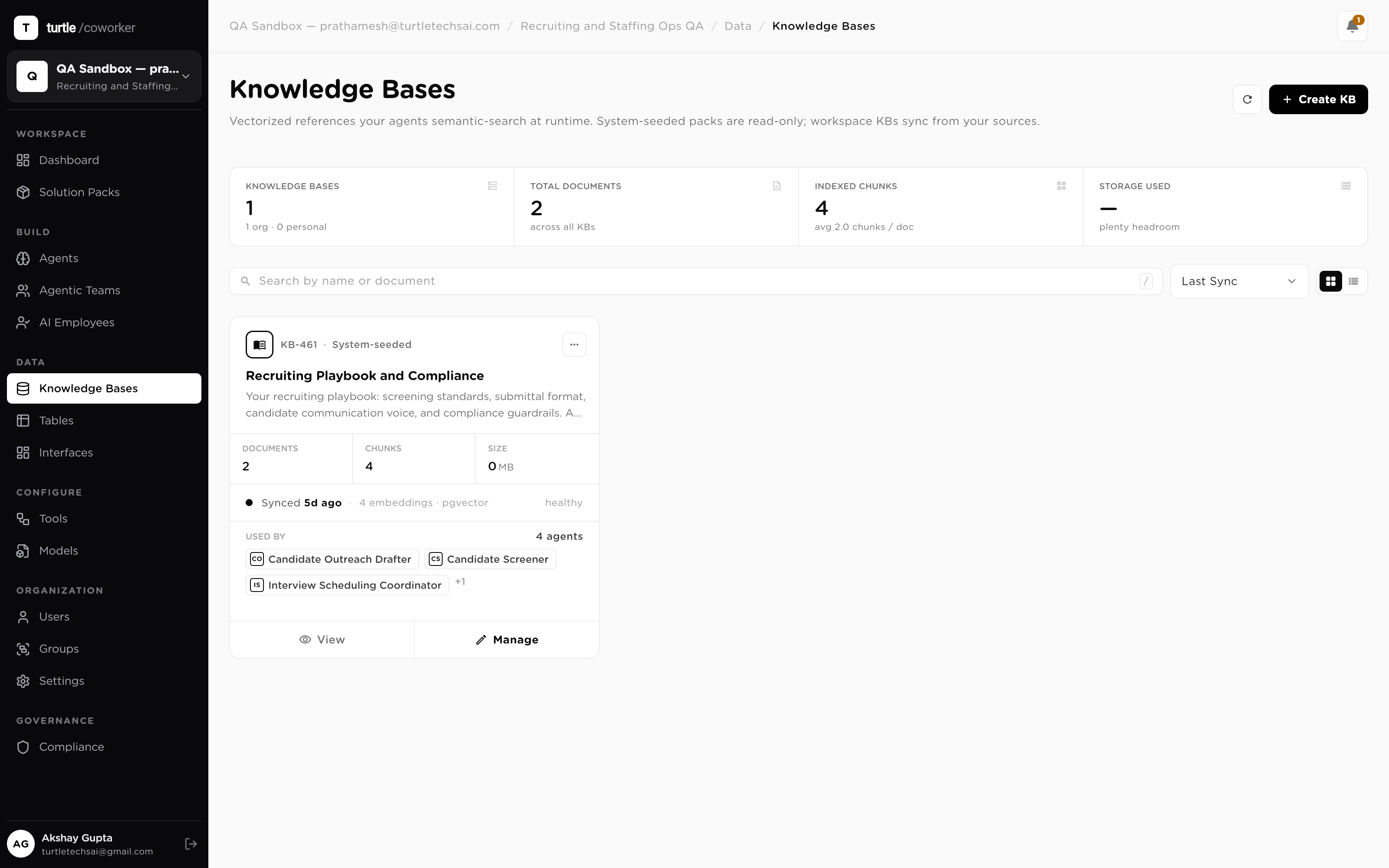
The failure isn't that ungrounded models are wrong often — it's that they're wrong fluently. Invented policy, a stale price, the wrong clause of the right document, delivered in the same confident register as the truth. Nobody catches it until it's been said to a customer.
So grounding here isn't a bolt-on. Retrieval runs before the answer, searches by meaning and by exact term, and the answer draws on passages you can check against the source. The corpus is read-only to every run, deduplicated as it's maintained, and honest about deletion — what it holds is exactly what your workers can say.
Each is the same mechanism — retrieve first, answer from the retrieved text — applied where a wrong answer costs real money.
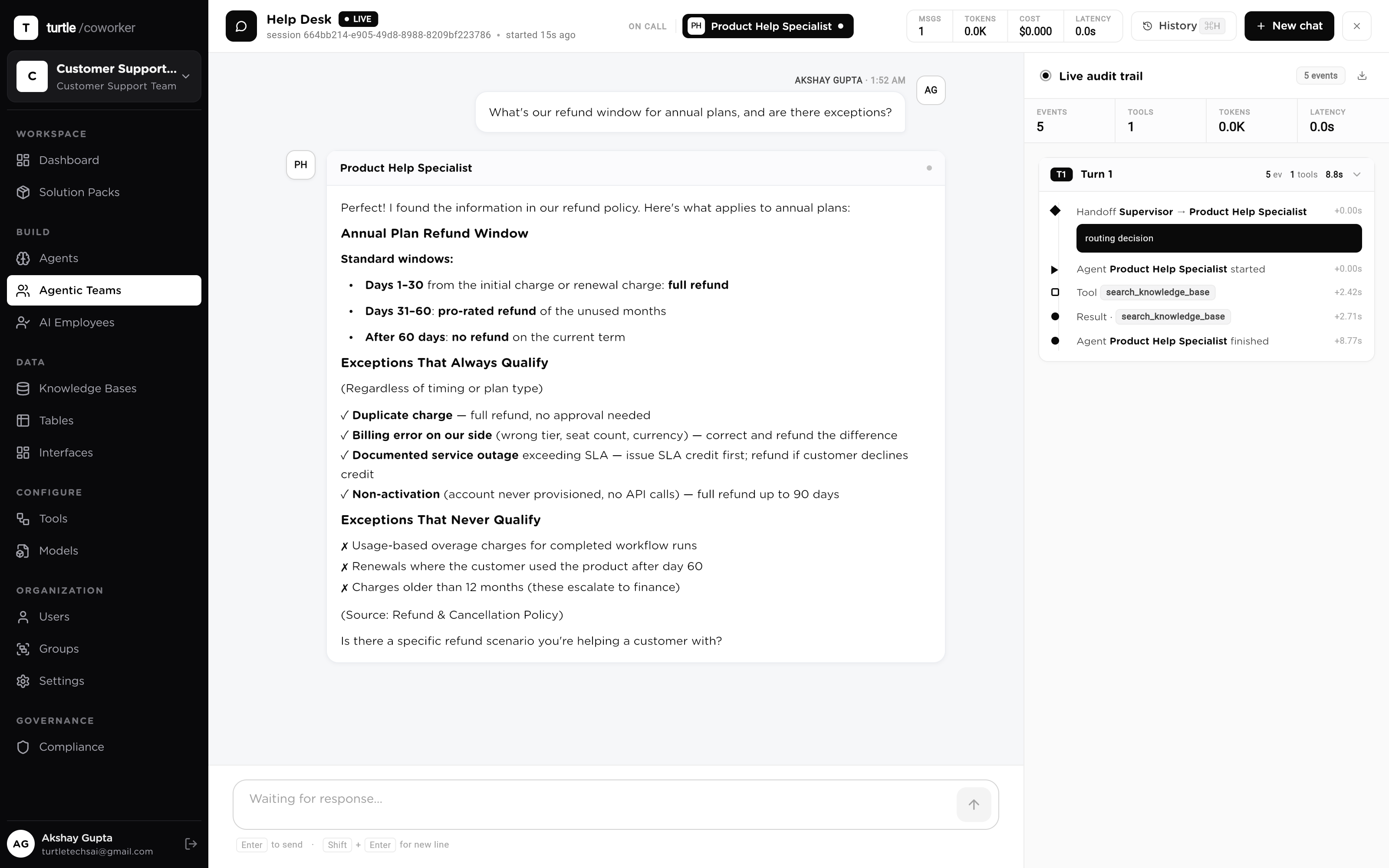
A customer asks about a refund past the 30-day window. An ungrounded model improvises something plausible. A grounded worker retrieves the actual clause and answers from it.
Vector search finds passages about refund timing; full-text search pins the exact terms — '30 days', the policy section number. RRF fuses the rankings.
The worker answers from the refund-policy manual's own words, citable to the passage — not from what refund policies usually say.
All support workers on the base ground identically, so the policy is stated once, correctly, everywhere.
An underwriting team's screening agent must apply the guidelines as written — not a model's recollection of how underwriting generally works.
For each application, it retrieves the passages governing that case type — exposure limits, exclusions, referral conditions — by meaning and by exact term.
The output points to the retrieved guideline passages, so a reviewer checks the source, not the model's reasoning from memory.
The base is read-only at run time; when guidelines change, the team updates the corpus and re-syncs — every screening after that uses the new text.
Your product docs change weekly. The workers answering from them should track the changes without anyone redeploying or editing an agent.
Docs live in the base as files, a crawled site or a synced wiki. Workers reference the base, not any particular version of a file.
Content hashing skips unchanged documents; changed pages re-embed. No duplicate chunks, no full rebuilds.
Every attached worker retrieves from the refreshed index on its next question. Zero worker config touched.
Last year's pricing sheet is obsolete. In a typical RAG stack its embeddings keep answering. Here, deleting it deletes its voice.
The old document is deleted from the base by someone with access — a deliberate, human act, not a run's side effect.
Deletion propagates to the vector index: the document's chunks are removed from retrieval, not just its listing.
No worker can retrieve the retired sheet again. What the corpus holds is exactly what workers can cite.
One team curates the authoritative base. Every worker in the workspace grounds on it — without the curators losing control of it.
Files, sites and synced sources in a single corpus, deduplicated as it's maintained.
Agents, teams and employees attach the same base; each retrieves from it at run time.
Every attached worker searches and cites. None can modify it. Curation stays with the curators.
Bring your knowledge in once; every agent, team and employee retrieves from it at run time — and none of them can write to it.
Six properties that separate a grounding layer from RAG bolted onto a chatbot.
An ungrounded model answers policy questions from its training data — fluently, confidently, and sometimes wrong. Attach a knowledge base and the worker searches it at run time first: the passages that actually match the question are retrieved and the reply is drafted from them, with the retrieved material available as evidence. The answer stops being an assertion and becomes a claim with a source.
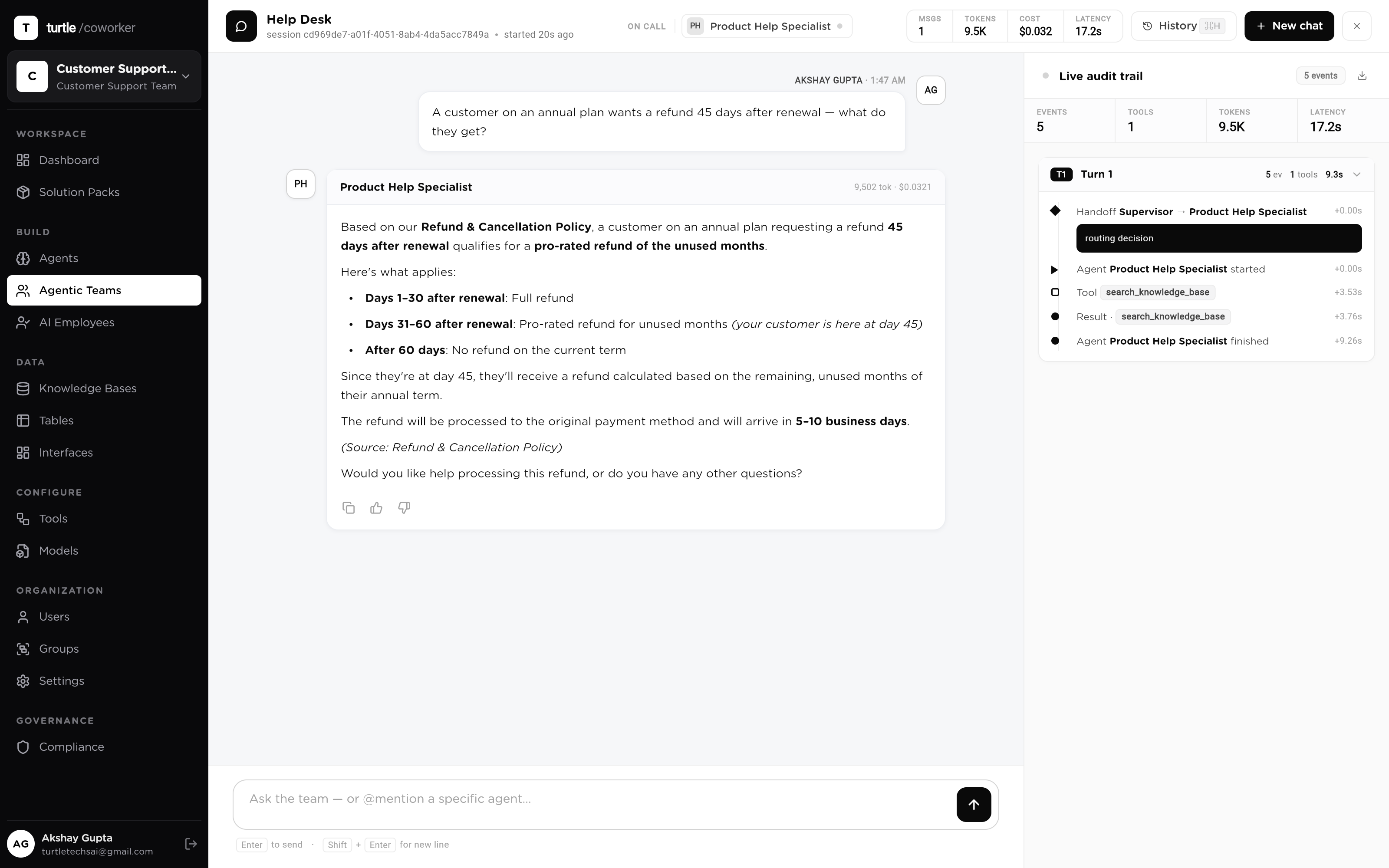
Pure vector search is famous for a specific failure: it retrieves what's similar and misses what's exact — the SKU, the clause number, the error code. Retrieval here runs two searches in parallel: dense vector search for meaning, and full-text search for the literal terms. The two candidate lists are fused with reciprocal-rank fusion, so a chunk that both searches agree on outranks a chunk only one found.
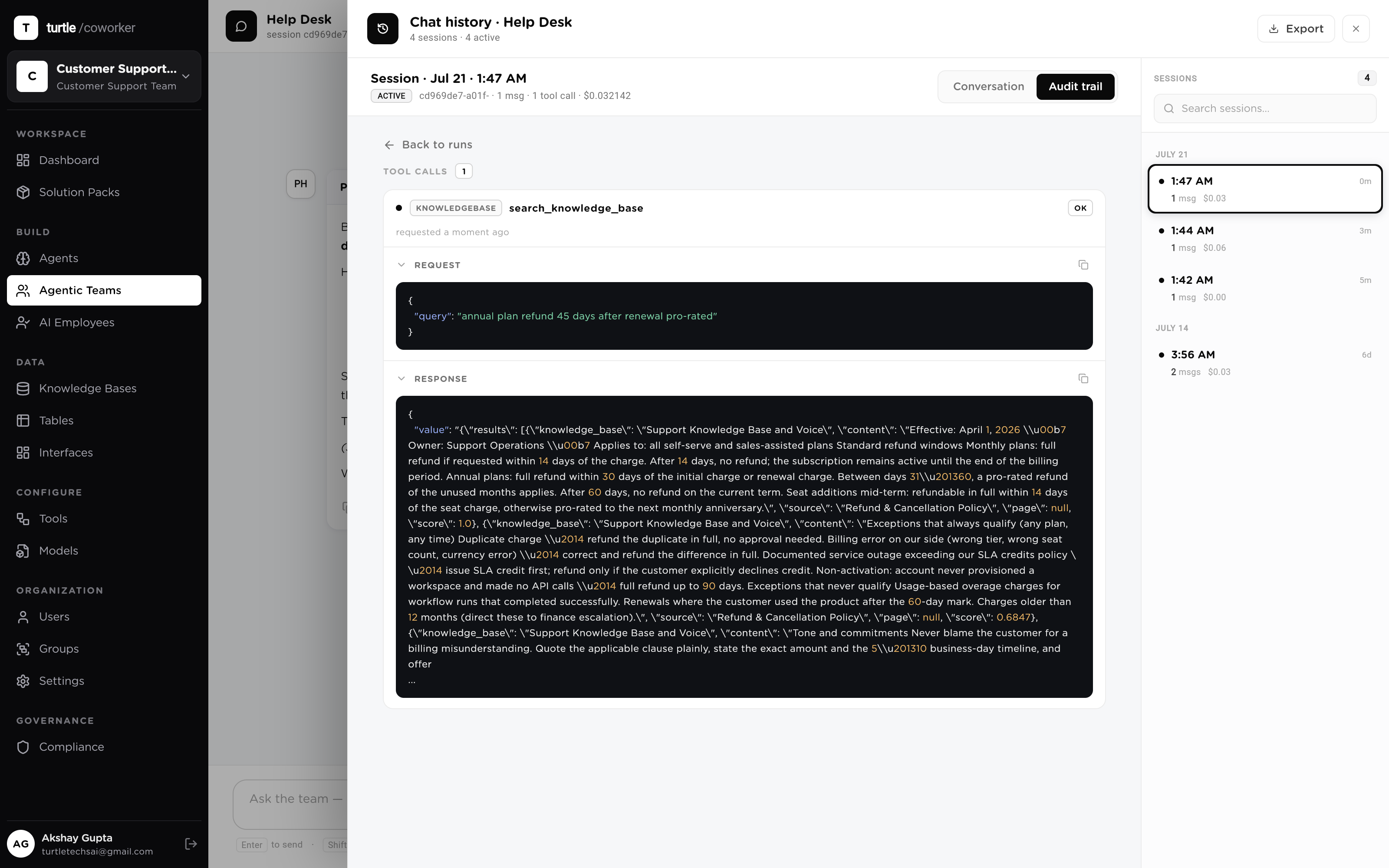
Point a base at what you already have: pasted text, uploaded files (PDF, DOC, TXT, MD), a crawled website, or synced sources from Google Drive and Notion. Everything is chunked and embedded automatically — there is no pipeline to build and no index to tune. Mix source types in one base and scattered institutional knowledge becomes one searchable thing.
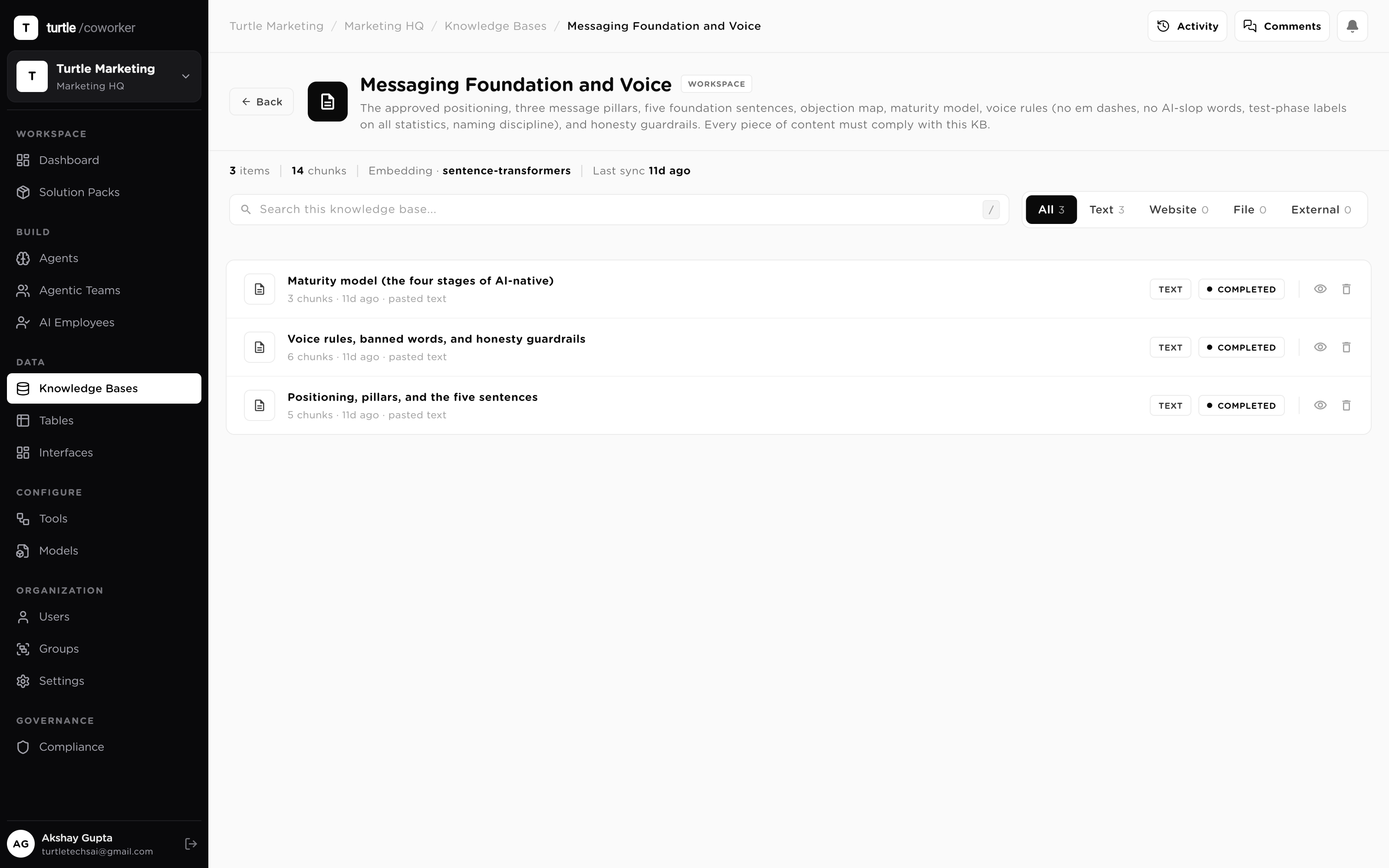
The quiet way RAG rots: every re-upload and re-sync adds another copy, and retrieval starts surfacing three versions of the same paragraph. Ingestion here fingerprints content by hash — an unchanged document is recognized and skipped, and a re-sync re-processes only what actually changed. The index stays one-copy-per-truth instead of accreting duplicates.
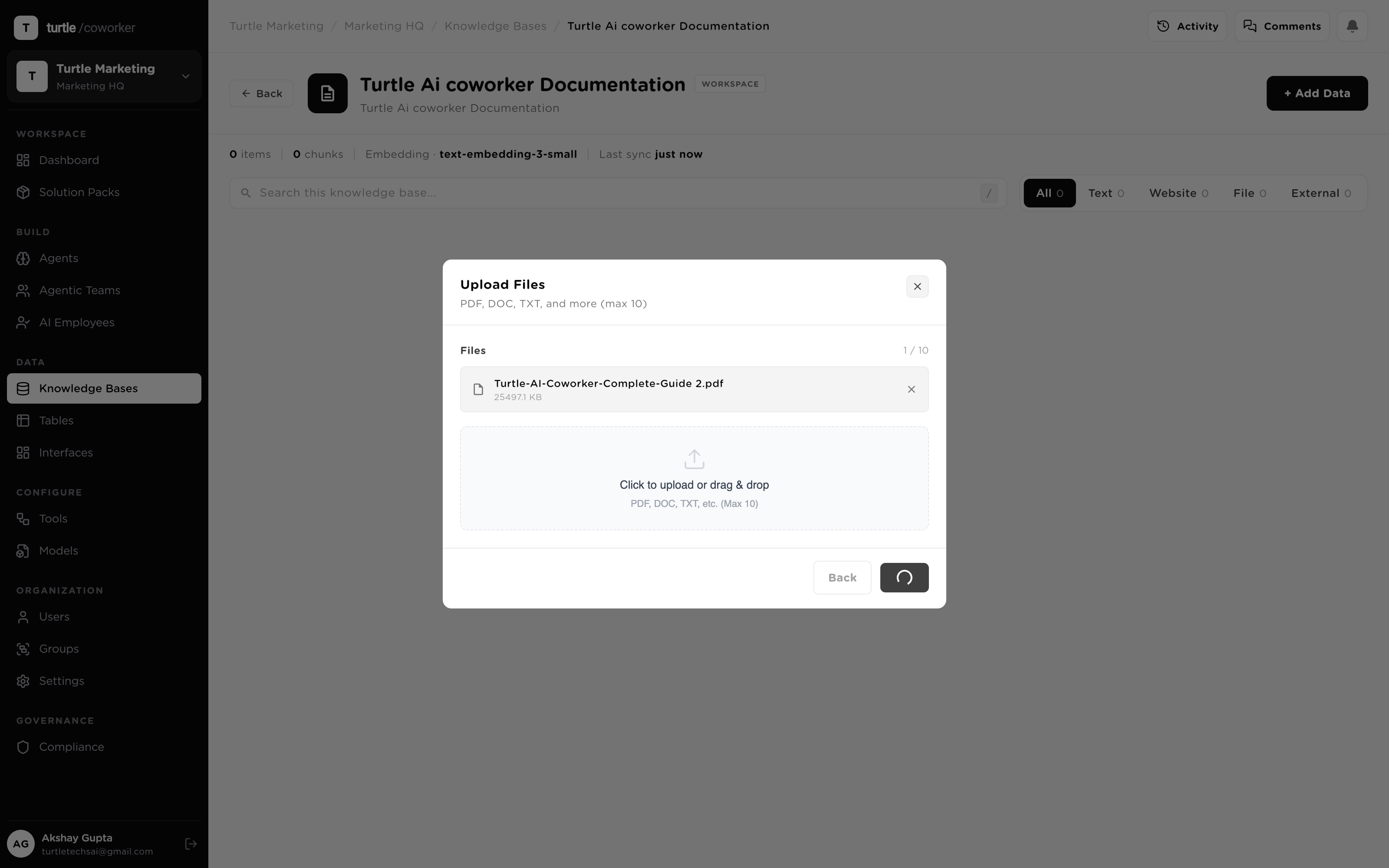
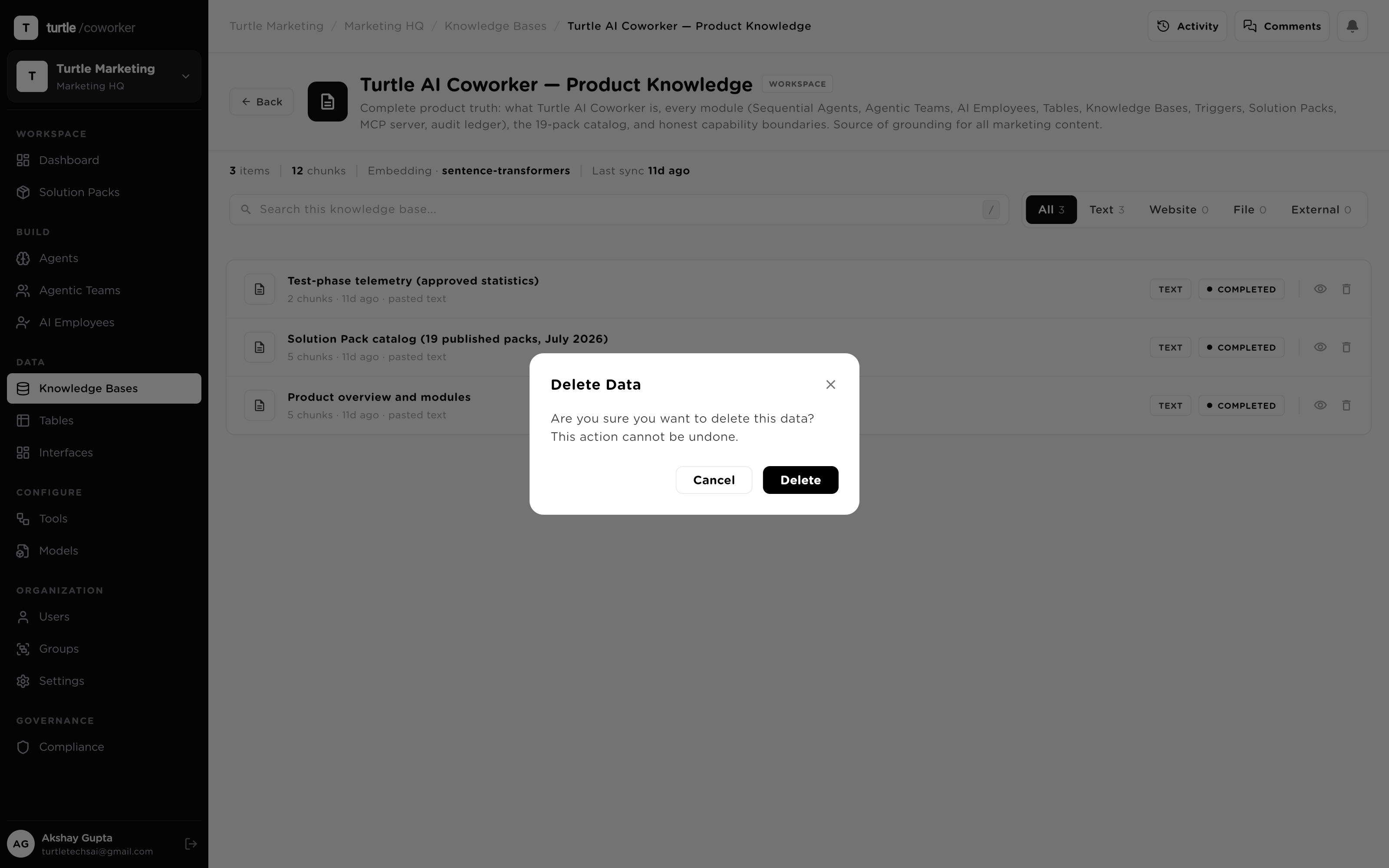
In a bolted-on RAG stack, deleting a file often deletes the file — and leaves its embedded chunks answering questions for months. Here deletion propagates: removing a source removes its vectors from the index, so a retired policy can't be retrieved and quoted after it's gone. What the corpus says is what your workers can say.
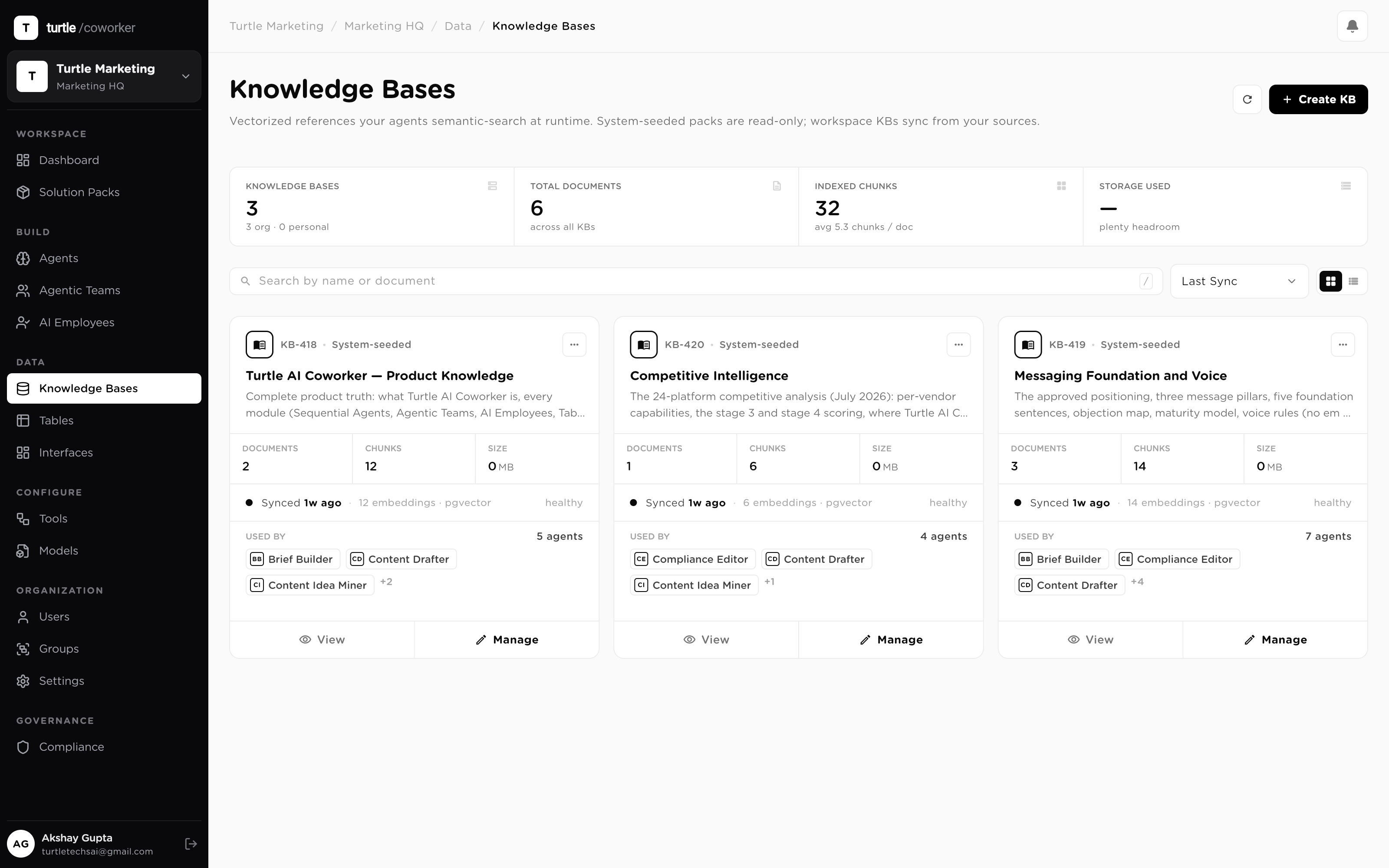
A knowledge base is read-only at run time — workers retrieve and cite; no run can mutate the corpus. That's a governance property, not a limitation: one misbehaving or prompt-injected worker can never poison the reference the rest of the workforce depends on. Retrieved chunks are also among the untrusted content the platform's injection shield can screen before they re-enter a model's context. Data workers should read and write lives in Tables, under per-verb permissions.
A support org grounds its workers in two bases — the product docs and the refund-policy manual. A customer asks for a refund 45 days after purchase. Here's what the system does with that question.
Workers search the base before answering; replies draw on retrieved passages, traceable to their source.
Vector and full-text search run in parallel and fuse with reciprocal-rank fusion — meaning and exact terms both surface.
Files, crawled websites, pasted text, Drive and Notion syncs — chunked and embedded automatically, mixed in one base.
Content is fingerprinted; unchanged documents are skipped on re-sync, so the index never accretes duplicates.
Removing a source removes its vectors — a retired document can't be retrieved into an answer.
No run can write the base. Updates are deliberate, human acts; the reference can't be poisoned mid-run.
Update the corpus and re-sync; every attached worker answers from the new material with no config change.
One base attaches to many workers — agents, teams, employees — so the same question gets the same grounded answer.
Complete operating system for a Chartered Accountant practice. Tracks clients, engagements, statutory deadlines, and IT/GST notices. Includes AI agents for notice triage, GST reconciliation, filing reminders, and client communication. Comes with an AI Employee (Priya) who coordinates compliance work end-to-end.
The accounts payable and bank reconciliation desk a fractional controller runs for a client. Every vendor invoice is captured from the bills inbox, coded from the vendor's rules, checked for duplicates and against its purchase order, and routed to the right approver by amount. Approved invoices become a posting pack for the ledger and a weekly payment run. Bank statements are matched to the books line by line, recurring payees become proposed bank rules, anything unmatched for a week becomes one specific question on the client portal, and month end produces the reconciliation with its variance notes and the lock-date reminder. Comes with Cass, an AP and Close Coordinator who runs the queue.
Signal-based outbound for a founder or a small GTM team. Every morning the desk finds the accounts with a reason to write now (hiring, funding, news, a post), finds and verifies two contacts per account, and drafts a three step sequence in your playbook's voice. You approve, and the email goes from your own inbox. Replies land in one queue, classified with the next step ready. Meetings get a one-page brief. Your CRM stays the record. Comes with Remy, an Outbound Coordinator who runs the morning queue.
Contracts drafted, sent, chased, filed and watched, with a person at every step that matters. A colleague requests a contract from the portal; the drafter fills the approved template from the request and the CRM and marks what it could not fill. A person reviews and sends it for signature. Every morning the unsigned envelopes are chased and the old ones escalated. When a contract is signed its key terms (payment, liability, termination, renewal, governing law) are read from the PDF into a table with anything non-standard flagged, and the signed copy is filed by counterparty and type under your naming convention. Every Monday the contracts inside their notice window get a renew, renegotiate or terminate note for the owner. Works with Dropbox Sign, Google Docs, Google Drive and HubSpot. No agent ever signs, voids or counter-signs. Comes with Ren, a Contracts Coordinator, a Contracts Helpdesk and a portal for requesters.
The support team's queue, prepared. Every new ticket is read, categorised, given a priority and a drafted reply from your help centre within a minute; a person reads and sends. Questions that keep coming back become draft articles. Bugs are escalated to engineering with the steps and the evidence attached. Calls are summarised into a ticket. At the end of the day the team gets the volume, the response time and the three complaints of the day. Works with your helpdesk (Zendesk, Freshdesk, Intercom, Help Scout, Gorgias, Front and others), your phone tool and your issue tracker. Nothing is sent, refunded or closed by the software. Comes with Sol, a Support Coordinator.
Founder-led content for a founder or a small team. Every morning the desk listens (Reddit, LinkedIn, X, YouTube) for what your buyers are asking, turns the best of it into ideas by pillar, and drafts posts in your voice for LinkedIn and X. You approve; the desk hands you the final text to paste and post. Comments and reactions on what you published are harvested, and the people who match your ICP become leads. A newsletter issue is assembled from the week. Monday tells you which pillar and format earned attention. Comes with Theo, a Content Producer.
We use analytics cookies to see which pages help and which don’t. Nothing loads until you choose. Cookie Policy

Hello there.
AI agent. It can make mistakes, and a human reviews anything that matters.