Solutions · Customer Support

Your whole support desk,
run by one AI-native workforce.

Ticket volume grows faster than any hiring plan, and the gap lands where staffing is thinnest: nights, weekends, launch days. An AI-native support function puts the whole desk on a workforce that triages and answers from your own docs on arrival, while every refund and reply still waits for a person.

Installed in minutes, not months. Governed and audited from the first run.

OVERNIGHTThis morning's desk
27 tickets resolved inside SLA
SLA held at 100%
1 refund holding for the lead
1 escalation routed to a person
one workforce · governed · audited · cfg v3
The whole function, on one workforce

Not a bot bolted onto the queue.
The support desk, end to end.

Every stage of the desk is worked by the right kind of worker (an unattended play, a team that faces your customers), all reading and writing one shared record, with your people at the gates that matter.

You delegate to one coworker. It runs the queue and brings you the calls that need a person.
runs on its own
Triage on arrival
  • Categorize and prioritize
  • Stamp the SLA clock
  • Jump security signals
runs on its own
Draft the reply
  • Answer from your docs
  • Cite the policy
  • Escalate the gaps
faces your market
Face the customer
  • Respond in the channel
  • Follow up on the thread
  • Route what needs a person
runs on its own
Resolve the money
  • Refunds above threshold hold
  • Show the rule and evidence
  • Release only on approval
holds for a person
runs on its own
Watch & report
  • Watch every SLA clock
  • Compile the briefing
  • Price per resolved ticket
One shared record underneath. Every stage reads and writes the same tickets, SLAs and policies, under one rulebook of gates, budgets and audit.
Every step lands in the audit trail, pinned to the config that ran, so the whole desk is provable afterwards.
One workforce, several kinds of worker

One team. The right shape of worker for each job.

You don't wire this together or choose an architecture. You describe the outcome; the workforce brings the right kind of worker to each part of the desk, and they all work from one shared record, under one set of rules.

Workers that run a play to the end

The repeatable plays (triage a ticket, clock the SLA, draft a grounded first response from your docs) run start to finish on their own, unattended, on every ticket the moment it lands, 2 PM or 2 AM.

A team that faces your customers

In-channel replies and follow-ups are met in the moment by a customer-facing team that answers from your docs, keeps the thread moving, and routes to a person the second it isn't sure.

A room of specialists for the hard tickets

When one ticket needs product, billing and policy answered together, a room of specialists assembles the response as one, each owning its part.

A coworker you delegate the queue to

You don't operate a dashboard. You talk to one coworker that runs the queue, remembers your standing instructions, and surfaces only the tickets that need you.

One shared record, one rulebook

Every worker reads and writes the same tickets, SLAs and policies, and every one obeys the same gates, budgets and audit. No worker is ever off the leash.

What you never build

There's no integration project and no architecture to pick. You delegate the outcome, the workforce assembles the right workers, and every one of them lands under the same gates and audit.

What this makes possible

The support org you'd staff for. Without staffing for it.

Run the math: coverage that holds a 4-hour SLA at 2 AM is a night shift you never fully fund, so the tickets that land off-hours wait for morning and the clock is already lost. The workforce owns the repeatable 80% continuously and hands your people the 20% that's genuinely theirs. The week shifts like this (a worked scenario, not a benchmark):

01
First response inside the SLA, at any hour

Triage and a grounded draft happen on arrival, 2 PM or 2 AM. The SLA clock stops being a staffing problem, and the night shift stops being where tickets go to wait.

02
Answers from your docs, never invented

Replies are drafted from your own docs and refund policy, retrieved and cited, with the source next to the text. What the docs don't answer escalates to a person instead of being guessed.

03
Humans keep the calls that are actually theirs

Refunds above threshold, angry enterprise threads, the judgment calls: routed to a named person with the full context attached, while the routine 80% is already handled and inside SLA.

04
The queue becomes a number you manage

Volume, SLA performance, held approvals and cost per resolved ticket, priced from real run spend, land in the morning briefing every day, not in a feeling defended after a bad week.

Support todayWith the workforce
2 AM ticketswait for the morning shifttriaged + drafted on arrival
First responseswritten one by onereviewed, not written
Refund decisionsburied in the inboxone queue, the rule shown
SLA breachesfound after the factflagged while there's time
Team's daykeyboard triagethe calls that need a human
What running it feels like

You run the desk from one conversation.

Byte isn't a dashboard you operate, it's the coworker you delegate the queue to. The night's tickets, the SLA outcomes, the refund that's holding: it arrives summarized, the pieces that need a person are already queued with their evidence, and each approval releases exactly one thing.

Every message, tool call and approval in this exchange lands in the audit trail. How the gates work →

LIVEMorning check-in with Bytesupport workspace
Byte, how's the desk this morning?
BY
Byte · Helpdesk coordinatorQuiet where it should be. Overnight 27 tickets came in and resolved inside the SLA, the clock held at 100%. One thread I routed to a person, and one needs you: a refund over the threshold is holding.27 resolvedSLA 100%1 held
search_kb(refund-policy) → §2: duplicate charge, full refund within 30 days
create_refund · $840 · Karvan Retail, over the $500 auto-approve threshold, client-facing
Refund reads right. Approved.
BY
Byte · Helpdesk coordinatorDone. That grant covered exactly this one refund, so nothing else moved on it. The customer already had the cited reply overnight; the money just executed now that you've signed. When they reply, it lands back here with the whole ticket attached, not in a shared inbox.single-use grantcited: refund-policy §2
refund executed · customer notified · logged to audit trail, cfg v3
Proof, not promises

One night across the whole desk.

A scenario: a SaaS support org with a 4-hour first-response SLA, day and night, and tickets that never stop arriving. These are real screens, not mockups.
LIVEOne overnight ticket, end to endrun #4211 · support workspace
2:14 AM
arrivedA refund request lands overnightBilling category, paying customer. The ticket text is screened by the injection shield before it can steer anything, and the 4-hour SLA clock starts.
2:14 AM
workforceTriaged on arrivalPriority set, category assigned, SLA due stamped on the row. A security-looking signal would have jumped the queue; this one is routine billing.
2:16 AM
workforceGrounded reply drafted and sentWritten from the refund-policy KB with citations attached. This org earned the gate down for cited, low-risk replies, so the first response goes out inside the SLA.
2:17 AM
heldThe $840 refund holdsAbove the $500 threshold, so it waits in the queue with the rule and the cited draft as evidence. The customer has an answer; the money hasn't moved.
8:31 AM
humanThe lead approvesThe support lead reviews the evidence in the morning queue and approves. Single-use grant: this one refund only, expired in 24 hours if left.
8:31 AM
doneRefund executed, night priced27 tickets handled inside SLA, one human decision, all of it in the audit trail, pinned to cfg v3.
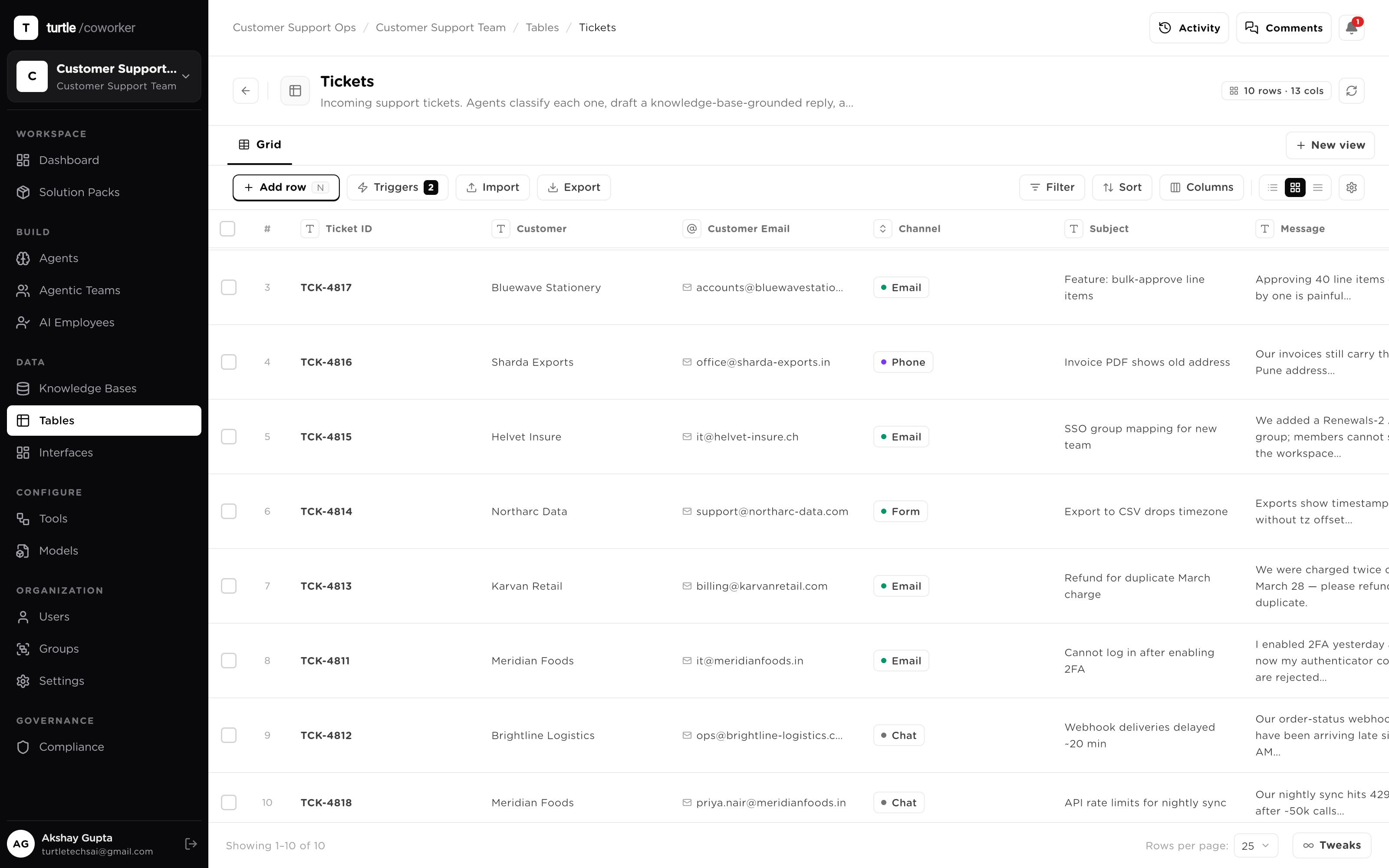
The Tickets table seeded with SaaS support tickets: subject, customer, category, priority and SLA-due columns filled by triage, with overnight timestamps (2–5 AM) visible on the newest rows
Triaged on arrival, the 2 AM tickets sorted before anyone logs on
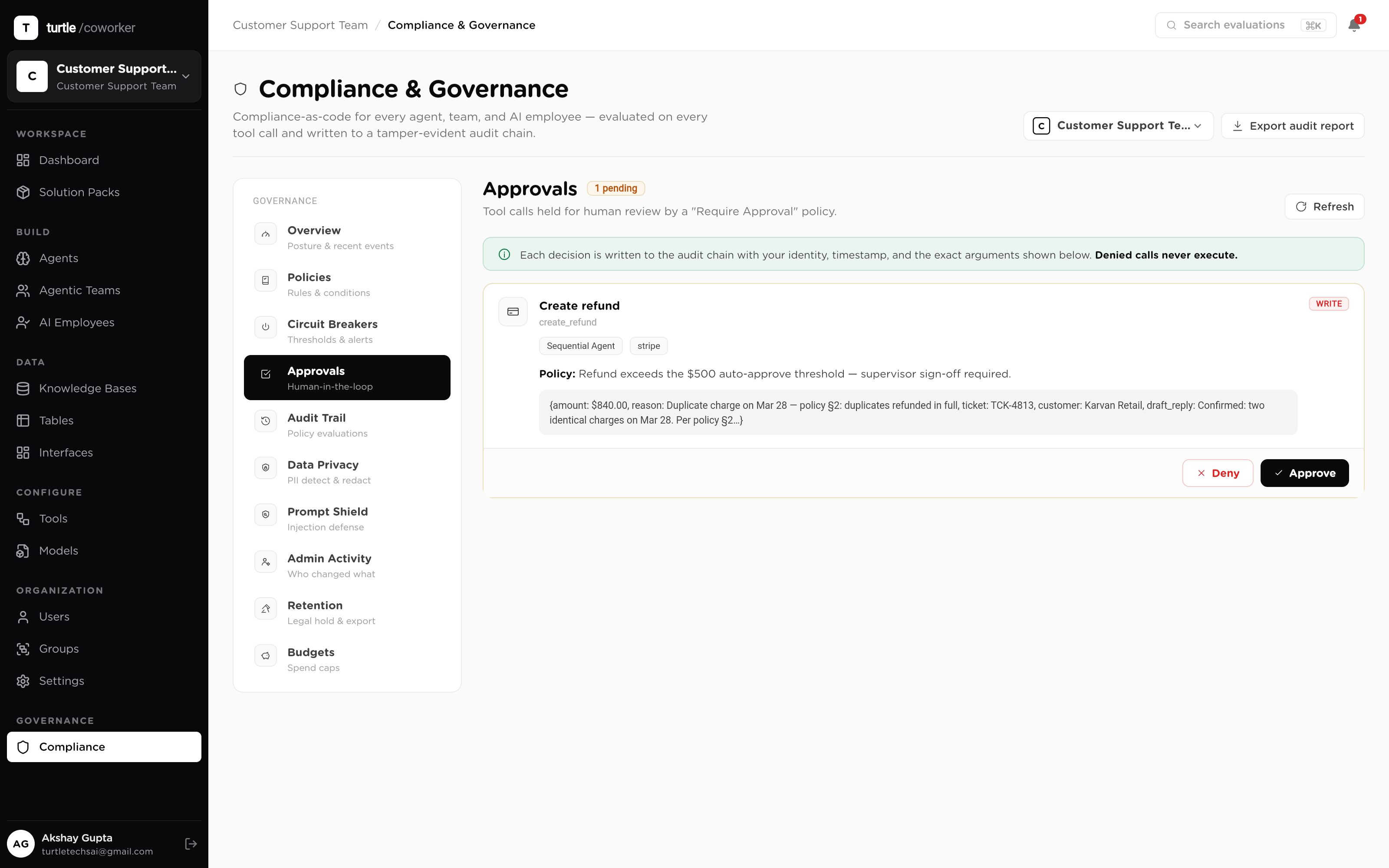
The approval queue with a held refund opened: the refund amount above threshold, the policy rule that held it, the cited draft reply beside it as evidence, and approve and deny controls
The money waits for a person, with the rule that held it shown
Governed by default

The gates ship with the system.

01 · GROUNDED, NOT GUESSED

Replies cite your docs

Drafts are retrieved from your knowledge bases and cite what they used; what the docs don't answer escalates to a human instead of a guess. Ticket text is untrusted input, so a prompt-injection shield screens it before it reaches a model. The control plane →

02 · REFUNDS HOLD

Money moves only on approval

Client-facing sends hold for review by default, and refund writes above your threshold always do, enforced at the tool call, at runtime, so an unapproved refund is a no-op. Each approval is single-use: one grant, one refund, then the next one asks again. How approvals work →

03 · AUDITED, AND PRICED

Every touch traced, every run costed

Every triage decision, draft, send, refund and escalation lands in the audit trail, pinned to the config version that ran, and every run's spend rolls up under budgets with hard caps, so cost per resolved ticket is a number you read, not estimate.

Questions

Before you install.

Is this one AI, or a lot of them?
One workforce, several kinds of worker. Some jobs run as unattended plays that go start to finish on their own (triage a ticket, clock its SLA, draft a grounded reply); in-channel replies are met by a customer-facing team; a hard ticket is assembled by a room of specialists; and you talk to one coworker that runs the queue. You never wire this together or choose an architecture. You delegate the outcome, and the workforce brings the right shape of worker to each part of the desk. Every one of them reads and writes the same record and obeys the same gates.
Does it auto-reply to customers?
Only where you decide it should. Every client-facing response sits behind an approval gate by default: the drafter prepares a grounded reply and a human skims, edits and sends. Once the drafts have earned it in a low-risk category, you can loosen the gate there and keep it tight where money or policy is involved. Refunds above your threshold always hold for a person.
How is this different from a deflection bot?
Deflection bots improvise. Here, replies are drafted from your own knowledge bases (product docs, refund policy, runbooks), retrieved and cited, and anything the docs don't answer escalates to a human instead of being guessed at. The failure mode is a handoff, not a made-up policy in a customer's inbox.
What happens when a ticket needs a human?
It routes to a named person, not a shared inbox, and it arrives with the full context attached: the thread, the account record, what the workers found and what they drafted so far. Escalation is a first-class outcome of triage, not an afterthought, and a security-looking signal escalates ahead of the routine queue. Inbound text is untrusted input, so a prompt-injection shield screens it before it can steer anything.
Does this replace our ticketing system?
No, it works with it. Tickets flow in from the ticketing tools you already run, and the priorities, categories and drafts live in your Tickets table alongside them. Your existing system stays client-facing; Byte and the workers are the workforce that triages, drafts and watches inside it, and hands the outcomes back where your team already lives.
How long until it's running?
Minutes, not months. You answer a few setup questions (which categories, which approval gates, which SLA targets), connect the ticketing tools you already run, and the installer wires the shared record, the workers and Byte together, verified with a smoke test and ready for a first run.
Solutions · Customer Support

The desk runs itself by morning. The refunds wait for your team.

Book a demo Browse Solution Packs