Solutions · Sales

Your whole sales motion,
run by one AI-native workforce.

Selling is a few human conversations wrapped in a mountain of repeatable work: research, list-building, first touches, inbound, proposals, CRM hygiene. An AI-native sales function puts the whole machine on a workforce that runs it continuously, while every send and every commitment still waits for a rep.

Installed in about 20 min. Governed and audited from the first run.

OVERNIGHTThis morning's desk
212 accounts scored against your ICP
2 inbound leads qualified & booked
14 first touches holding for a rep
1 proposal holding for sign-off
one workforce · governed · audited · cfg v7
The whole function, on one workforce

Not a bot bolted onto outreach.
The sales motion, end to end.

Every stage of the motion is worked by the right kind of worker (an unattended play, a team that faces your market, a room of specialists), all reading and writing one shared record, with your reps at the gates that matter.

You delegate to one coworker. It runs the desk and brings you the calls that need a person.
runs on its own
Build the list
  • Enrich every target account
  • Score it against your ICP
  • Write the account brief
runs on its own
Reach out
  • Draft first touches from real signals
  • Sequence the follow-ups
  • Personalize from the brief, cited
holds for a person
faces your market
Handle the inbound
  • Qualify site & reply traffic
  • Answer from your docs
  • Book the meeting
a room of specialists
Move the deal
  • Assemble the proposal
  • Pull competitive positioning
  • Draft pricing to your floor
holds for a person
runs on its own
Read the pipeline
  • Keep the CRM clean
  • Compile the morning briefing
  • Flag what needs a human
One shared record underneath. Every stage reads and writes the same accounts, scores and deals, under one rulebook of gates, budgets and audit.
Every step lands in the audit trail, pinned to the config that ran, so the whole motion is provable afterwards.
One workforce, several kinds of worker

One team. The right shape of worker for each job.

You don't wire this together or choose an architecture. You describe the outcome; the workforce brings the right kind of worker to each part of the motion, and they all work from one shared record, under one set of rules.

Workers that run a play to the end

The repeatable plays (research an account, build the brief, draft a sequence) run start to finish on their own, unattended, overnight.

A team that faces your market

Inbound chat and replies are met in the moment by a market-facing team that answers from your docs and books the meeting, and escalates the second it isn't sure.

A room of specialists for the hard deals

When a deal needs a proposal, competitive positioning and pricing at once, a room of specialists assembles it together, each owning its part.

A coworker you delegate the desk to

You don't operate a dashboard. You talk to one coworker that runs the desk, remembers your standing instructions, and surfaces only what needs you.

One shared record, one rulebook

Every worker reads and writes the same accounts, scores and deals, and every one obeys the same gates, budgets and audit. No worker is ever off the leash.

What you never build

There's no integration project and no architecture to pick. You delegate the outcome, the workforce assembles the right workers, and every one of them lands under the same gates and audit.

What this makes possible

Coverage without the spray. Volume without the risk.

Run the math: six reps at twenty genuinely researched accounts a day is 120, so one pass over a 5,000-account list takes two quarters and it's stale before you finish. The workforce runs the whole motion continuously and hands your reps the judgment. The week shifts like this (a worked scenario, not a benchmark):

01
The whole list worked, not the reachable slice

Every target account enriched, briefed and scored against your ICP overnight, with the reasoning written next to the number, not just a rank. Coverage stops being a headcount problem.

02
Inbound answered in the moment, not next business day

Site and reply traffic is qualified and booked when it lands, 2 PM or 2 AM, grounded in your docs and escalated the instant it isn't sure. The lead never goes cold in a queue.

03
Deals assembled while they're still hot

When a deal is ready, the proposal, the competitive positioning and pricing to your floor are drafted together in an hour, and every client-facing piece still waits for a rep.

04
The pipeline reads true, and priced

The CRM stays clean without a rep babysitting it, and every run's spend rolls up, so cost per booked meeting is a number in the morning briefing, not a feeling defended in the QBR.

Sales todayWith the workforce
Account research20 per rep-daythe whole list, nightly
Inbound repliesnext-day, if at allqualified in the moment
Proposal prepdays of rep timedrafted in an hour, rep-signed
The send buttonanyone's, anytimeone single-use grant per send
Reps' hoursspread thin on adminspent in the conversations
What running it feels like

You run the desk from one conversation.

Sasha isn't a dashboard you operate, it's the coworker you delegate the desk to. The night's scoring, the inbound that came in, the deal that's ready: it arrives summarized, the pieces that need a rep are already queued with their context, and each approval releases exactly one thing.

Every message, tool call and approval in this exchange lands in the audit trail. How the gates work →

LIVEMorning check-in with Sashasales workspace
Sasha, how's the desk this morning?
SA
Sasha · Sales development leadQuiet where it should be. Overnight I scored 212 accounts: 41 qualified, and 14 first-touch drafts are waiting at your gate. Two inbound leads came in after hours, both qualified and booked. And the Meridian proposal is assembled and holding for your sign-off.212 scored2 inbound booked1 proposal held
assemble_proposal(Meridian) → pricing to floor · positioning vs. incumbent
send_proposal · Meridian Logistics · $48k ACV, client-facing, waits for a rep
Proposal reads right. Approved.
SA
Sasha · Sales development leadSent. That grant covered exactly this one proposal, so the 14 first touches are still holding separately. When Meridian replies, it lands back here with the whole deal context attached, not in a shared inbox.single-use grantcfg v7
proposal released · reply routing armed · logged to audit trail, cfg v7
Proof, not promises

One night across the whole motion.

A scenario: a B2B company with a 5,000-account ICP list, six reps, and inbound that never stops. These are real screens, not mockups.
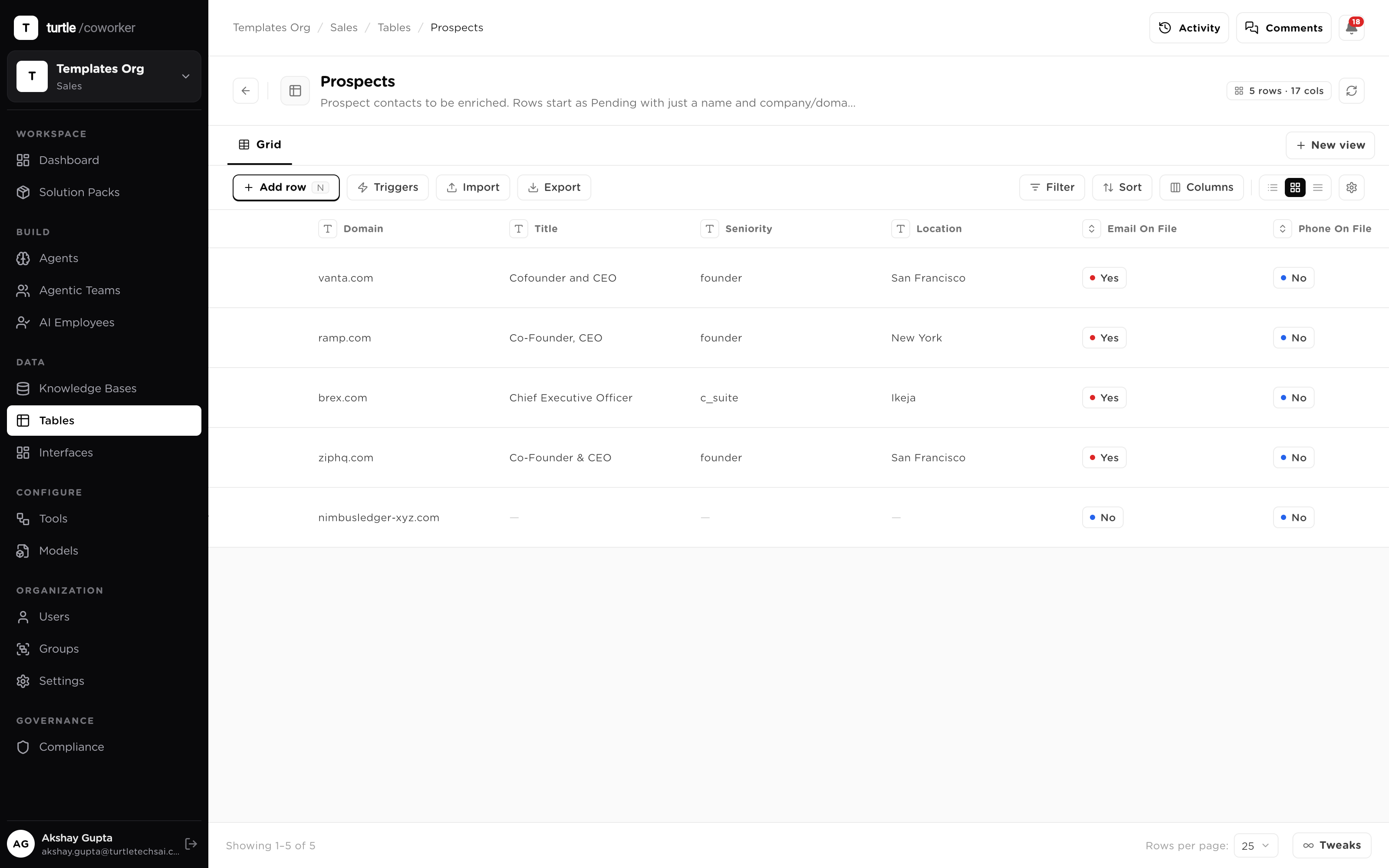
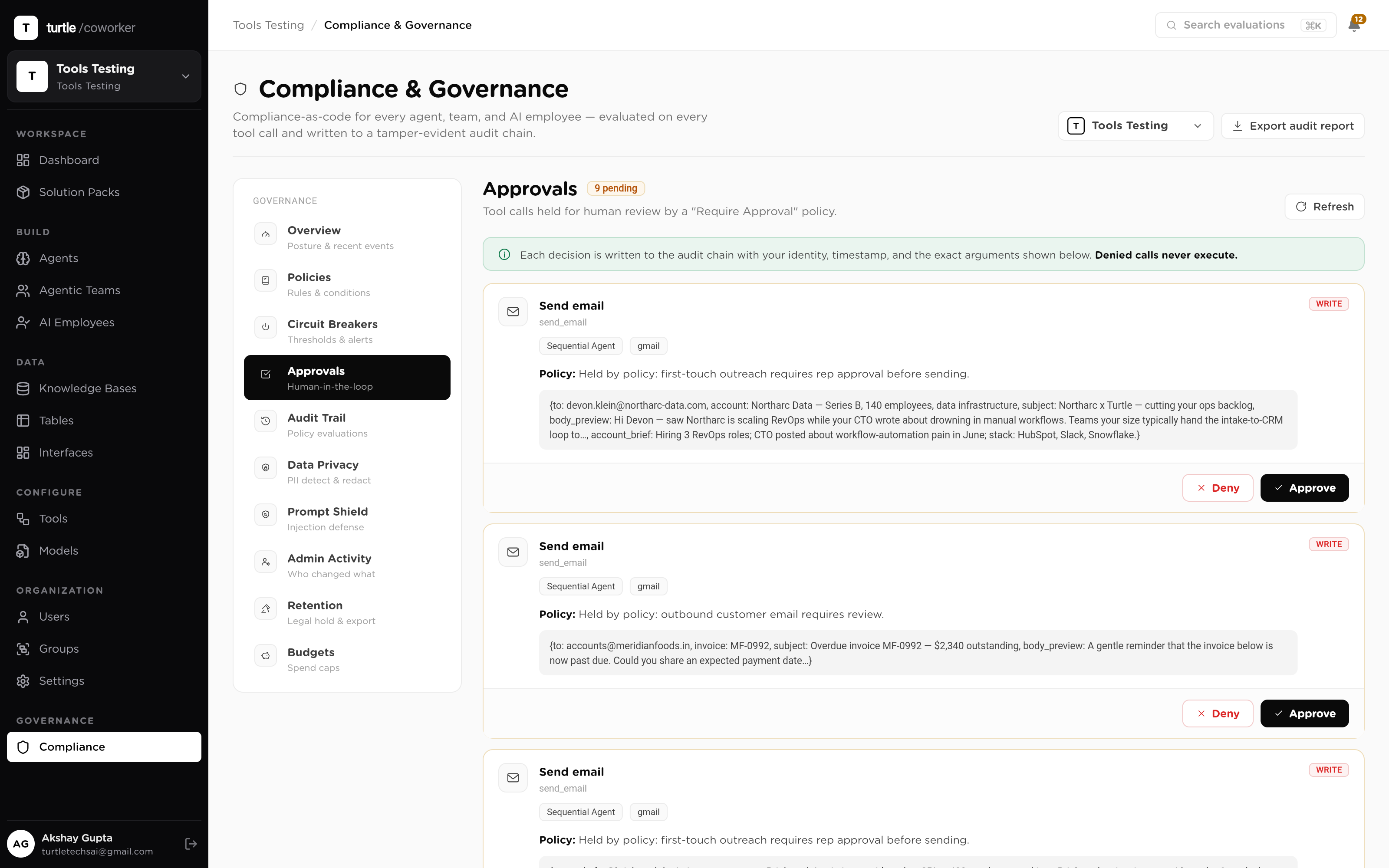
LIVEOne night, list to first replyrun #5117 · sales workspace
11:41 PM
arrivedThe nightly run picks up the list212 new and changed target accounts enter the run: the whole list, not the slice a team could reach by hand.
12:03 AM
workforceScored, briefed, written to the recordEach account enriched and scored against the ICP, reasoning written to the shared record beside the number. 41 cross the threshold tonight.
6:52 AM
workforceAn after-hours lead, qualified and bookedA form fill lands before the team is up. The market-facing team answers from your docs, qualifies it against the ICP, and books the meeting. Grounded, not improvised.
8:40 AM
heldThe Meridian proposal holdsThe deal is ready, so the proposal, the positioning and pricing to your floor are assembled together, then the client-facing send stops in the approval queue with the whole package as evidence. Nothing has left the building.
9:05 AM
humanThe AE signs the morning queue14 first touches and one proposal, each reviewed with its context. 12 approved as written, 2 edited first. Each approval is a single-use grant: one grant, one send, expired in 24 hours if unused.
11:52 AM
doneFirst reply, routed with the whole dealMeridian answers. The inbound text is screened by the injection shield, then routed to the AE with the brief, the score and the thread. The whole night in the audit trail, pinned to cfg v7.
The Accounts table scored and prioritized against the ICP: company rows with the score and priority columns filled in by the overnight run
Scored overnight, priority on every account before anyone logs on
A held outreach email in the approval queue: the drafted first touch shown as evidence, with approve and deny controls beside it
Every client-facing send waits here until a rep signs it
Governed by default

The gates ship with the system.

01 · THE SEND IS YOURS

Nothing client-facing leaves without a human

First touches and full proposals alike hold at the approval gate, enforced at the tool call, at runtime, so an unapproved send is a no-op. Each approval is single-use: one grant, one send, 24-hour expiry. The domain and the brand stay protected at scale. How approvals work →

02 · INBOUND IS UNTRUSTED

Replies are screened before they steer anything

A prospect's reply is untrusted input, so a prompt-injection shield screens inbound text before it reaches a model. Drafts stay grounded in your own docs and notes, cited; an account the docs can't ground escalates instead of getting a guess. The control plane →

03 · AUDITED, AND PRICED

Every touch traced, every run costed

Every score, draft, approval and send lands in the audit trail, pinned to the config version that ran, and every run's spend rolls up under budgets with hard caps, so cost per booked meeting is a number you read, not estimate.

Get the whole motion, pre-wired
Sales Engine Official
Everything on this page (the shared record, the workers, Sasha, the gates) installs as one system in about 20 min, verified with a smoke test. The full blueprint is readable before you sign up.
Start smaller

Sales templates, ready to clone.

All templates
Deals Table Template Template
Sales pipeline tracking all active and recently closed deals.
Lead Scorer (ICP Fit) Template
Scores any B2B lead for fit against your Ideal Customer Profile on a 1-100 scale using a fixed, weighted rubric (firmographic, persona, engagement and intent, offer-need fit, minus disqualifiers), then returns a tier (Hot, Warm, Cool, Low, or Disqualified), specific reasons, risks and unknowns, and a recommended next action and channel. Pure standalone: paste your lead details and ICP, get a consistent, readable qualification call. No tools or tables required.
Website Sales Concierge Template
A customer-facing pre-sales chat team for your website. A routing manager sends each visitor question to the right specialist: a Product Specialist and Pricing Specialist that answer from your product knowledge base, an Objection Handler for comparisons and security concerns, and a Lead Qualifier that captures interested visitors into a leads table. Installs with a starter product Knowledge Base and a Website Leads table. Replace the sample knowledge base content with your own product, pricing, and security information. Grounded in the knowledge base, with no invented claims.
Outbound Account Intelligence Template Template
Sales research table for ranking target accounts, summarizing ICP fit, and surfacing buying signals before outreach.
Discovery Call Prep Template
Turns your account and contact context into a focused discovery-call game plan: a briefing that separates facts from inferences, tailored open-ended discovery questions (Situation, Pain and Impact, Decision Process), the objections this specific buyer is likely to raise with honest responses, and a call agenda with the one outcome to drive toward. Pure standalone, no tools or tables required.
SMS and WhatsApp Campaign Copy Template
Writes a short-form SMS or WhatsApp sequence from your audience and offer: a messaging plan with tone, call to action, and compliance notes, then a ready-to-send sequence with character counts, an A/B variant, send timing, and a built-in opt-out on the first message. Brief, human, and compliant. Pure standalone, no tools or tables required.
Call Notes to CRM Summary Template
Turns raw call notes or a transcript into a clean, CRM-ready summary in seconds: attendees, a short recap, the prospect's pains and needs, action items each with an owner, buying signals, risks, plus a suggested deal stage, the primary next step, and a paste-ready CRM note. Extracts only what was actually said. Pure standalone, no tools or tables required.
Cold Email Personalizer Template
Writes a personalized, multi-touch cold email sequence from your prospect's details and your offer. Returns a personalization angle, ready-to-send emails with subject-line options and send timing, an A/B variant of the first email, and a quick deliverability check. Pure standalone: paste who you're emailing and what you sell, get a sequence you can send today. No tools or tables required.
Discovery Call Prep Template Template
Sales preparation table for discovery calls, objection forecasting, and meeting-specific briefing.
Sales Engine Pro: Deal Desk (Internal) Template
Internal, rep-facing companion team for the Sales Engine Pro pack. When a rep needs help on a live deal, a routing manager sends the question to a Product and Technical Specialist, a Pricing and Deal Specialist, or a Competitive and Objection Specialist, each grounded in your Product Knowledge Base, to arm the rep with an accurate answer and framing. Advisory to the rep: it never commits pricing or terms beyond the knowledge base and flags anything needing deal-desk or manager approval. Pairs with the customer-facing Website Sales Concierge. Install alongside the Sales Engine Pro pack. Requires an LLM provider. Replace the sample product knowledge base with your own.
CRM Data Hygiene Auditor Template
Reads your CRM Contacts table and audits it for data-quality issues: missing key fields, malformed emails, likely duplicates, stale records, and placeholder or test junk. Groups findings by issue type with the specific record and exact problem, then produces a prioritized cleanup plan with the fix for each and a sensible order of operations. Installs with its CRM Contacts table.
Proposal Writer Template
Turns client context, scope, and pricing into a clear, persuasive, client-ready proposal: executive summary, understanding of the client's situation, proposed solution mapped to their needs, scope and deliverables, timeline, investment, why-us, and next steps. Leads with the client's problem and uses only the facts you provide. Pure standalone, no tools or tables required.
Pipeline Risk Analyzer Template
Reads your Sales Opportunities table and flags at-risk open deals using signals like stalled activity, past-due or imminent close dates, missing next steps, and low win probability for late-stage deals, then prioritizes them by value and risk with a recommended recovery action for each and totals the pipeline value at risk. Installs with its Sales Opportunities table.
Competitor Objection Response Template
Takes an objection or competitor comparison and returns a composed, credible response: a diagnosis of the real concern underneath, an acknowledge-reframe-redirect structure, proof points drawn only from your stated strengths, a redirect question, and both a spoken version for live calls and a written version for email. Never bashes competitors. Pure standalone, no tools or tables required.
Prospect Enrichment Template
Enriches a prospect from partial details (name plus company, email, or LinkedIn) using Apollo, returning a confirmed professional profile: title, company, seniority, location, tenure, and reachability, plus a relevance read and suggested approach. Uses people-search as the reliable path, never requests raw contact reveals, and never exposes or fabricates an email or phone. Requires the Apollo connector (shared platform key, low setup).
Opportunity Qualifier Template
Assesses how real and winnable an opportunity is using BANT, MEDDIC, or MEDDPICC. Marks each framework element Confirmed, Partial, or Missing, gives an honest qualification health read, lists the biggest gaps and risks in priority order with the exact question or action to close each, and ends with a go, nurture, or disqualify lean. Pure standalone, no tools or tables required.
Live Call Co-pilot Template
An internal real-time assistant for sales reps on or preparing for a call. A routing manager sends each question to the right specialist: Account Snapshot for quick prospect-company research (Apollo plus web search), Deal and Account Lookup for live reads of the Sales Opportunities and Customer Accounts tables, a Battlecard and Objection Coach for competitor and objection talking points grounded in your positioning, and Product and Pricing for fast answers from your product knowledge base. Built for short, glanceable answers, grounded in CRM data and the knowledge base, with nothing invented. Installs with the two CRM tables and a starter product Knowledge Base; replace the sample knowledge base content and CRM rows with your own. Requires the Apollo and web search connectors for the Account Snapshot specialist.
Employee Engagement Team Template
Run surveys, plan events, and generate engagement reports
Raj Coordinator Template Template
Sales operations AI employee for pipeline reviews, prospect research, lead qualification, email drafting, and handoff coordination. Includes embedded deals/prospects tables, a sales playbook KB, and three specialized agents.
Questions

Before you install.

Is this one AI, or a lot of them?
One workforce, several kinds of worker. Some jobs run as unattended plays that go start to finish on their own; inbound is met by a market-facing team; a hard deal is assembled by a room of specialists; and you talk to one coworker that runs the desk. You never wire this together or choose an architecture. You delegate the outcome, and the workforce brings the right shape of worker to each part of the motion. Every one of them reads and writes the same record and obeys the same gates.
Does it replace our CRM?
No, it feeds it. The workforce keeps its working surface in tables with typed columns (accounts, scores, briefs, opportunities) and hands results back to the CRM your reps already live in. The CRM stays the system of record; the tables are where the overnight and in-the-moment work happens, and everything the workforce touches lands there first.
What still actually needs my reps?
The judgment and the relationship. Every client-facing send, a first touch or a whole proposal, holds at an approval gate and releases on a single-use grant, so a rep signs each one. Pricing below your floor, live negotiation, the executive relationship, the call on a non-standard deal: those stay human by design. The workforce clears the repeatable machine so your reps spend their hours where a person changes the outcome.
What stops quality collapsing when the volume goes up?
Two things the shortcuts never had. Every draft is grounded in an account brief a worker just wrote, real firmographics and triggers from their site and your notes, cited, not a first-name token, and an account with nothing real to say escalates instead of getting a generic touch. And every draft still crosses a rep's desk before it sends, so the floor on quality is your reps' judgment, applied in seconds per draft instead of twenty minutes of research per account.
What happens when a prospect replies?
The reply routes to the owning rep with the account's full context attached: the brief, the score and its reasoning, the thread so far, not into a shared inbox to be rediscovered. Inbound text is untrusted input, so a prompt-injection shield screens it before it can steer anything; a reply can inform the next draft, but it can never command the system.
How long until it's running?
About 20 min. You answer a few setup questions (your ICP, daily limits, which approval gates), connect the outreach and CRM tools you already run, and the installer wires the shared record, the workers and Sasha together, verified with a smoke test and ready for a first run.
Solutions · Sales

The motion runs itself by morning. The sends wait for your reps.

Book a demo Install Sales Engine