Solutions · Legal

First-pass review by morning,
final say always counsel's.

The contract queue is where routine paper eats the hours that belong to real matters, intake lives in untracked email, and generic AI is a confidentiality non-starter. An AI-native legal function reviews every inbound agreement against your own playbook the day it arrives, while nothing leaves the building without counsel.

Installed in about 20 min. Governed and audited from the first run.

OVERNIGHTThis morning's desk
6 NDAs reviewed to playbook
14 deviations flagged with the rule
3 redlines holding for counsel
1 signature holding for sign-off
one workforce · governed · audited · cfg v5
The whole function, on one workforce

Not a bot bolted onto contract review.
The intake motion, end to end.

Every stage of the motion is worked by the right kind of worker (an unattended play, a room of specialists for the hard agreements), all reading and writing one shared record, with counsel at the gates that matter.

You delegate the first pass to one coworker. It runs the desk and brings you the calls that need counsel.
runs on its own
Intake the matter
  • Log the contract
  • Open a matter row
  • Categorize the request
a room of specialists
Review vs playbook
  • Check standard positions
  • Flag every deviation
  • Cite the playbook rule
runs on its own
Draft the redline
  • Propose the changes
  • Escalate what it can't ground
  • Attach the rationale
runs on its own
Release
  • No redline leaves without counsel
  • No signature, no filing
  • Release only on approval
holds for a person
runs on its own
Track & report
  • Keep the matter table
  • Compile the briefing
  • Audit every access
One shared record underneath. Every stage reads and writes the same matters, playbook and documents, under one rulebook of gates, budgets, confidentiality and audit.
Every step lands in the audit trail, pinned to the config that ran, so the whole motion is defensible afterwards.
One workforce, several kinds of worker

One team. The right shape of worker for each job.

You don't wire this together or choose an architecture. You describe the outcome; the workforce brings the right kind of worker to each part of the motion, and they all work from one shared record, under one set of rules.

Workers that run a play to the end

The repeatable plays (intake an agreement, run the first pass against your playbook) go start to finish on their own, unattended, the moment a contract lands, day or night.

A room of specialists for the hard agreements

When an agreement is complex enough that liability, term and IP have to be weighed together against the playbook, a room of specialists assembles the review, each owning its part.

A coworker you delegate first-pass to

You don't operate a dashboard. You talk to one coworker that runs the intake desk, holds your standing instructions, and brings you only the clauses that need counsel.

One shared record, one rulebook

Every worker reads and writes the same matters, playbook and documents, and every one obeys the same gates, budgets and audit. No worker is ever off the leash.

Privileged material that never leaves the building

Confidentiality is enforced, not promised: access scoped by org role, a PII policy over what agents store, and nothing external released without counsel at the gate.

What you never build

There's no integration project and no architecture to pick. You delegate the outcome, the workforce assembles the right workers, and every one of them lands under the same gates and audit.

What this makes possible

Counsel hours go to matters, not paper.

Not a chatbot with a law degree it doesn't have: a workforce that does the first pass against your positions and hands counsel the judgment calls with the evidence attached. The week shifts like this (a worked scenario, not a benchmark):

01
First-pass review in minutes, not days

Every inbound NDA and routine contract is read against your playbook (your standard positions, fallback clauses, walk-away terms) the day it arrives, and each deviation names the rule it breaks. The contract queue stops being where deals go to wait.

02
Intake becomes a tracked queue, not an inbox

Every agreement that arrives becomes a matter row in a typed table: counterparty, type, status, owner, due date. Nothing lives in someone's email; nothing goes quiet; nothing gets rediscovered late.

03
Document questions answered, with the citation

Questions about a playbook rule or a precedent are answered from your own knowledge bases with the citation attached. Anything the documents can't ground escalates to counsel instead of being guessed at.

04
Nothing leaves the building without counsel

No redline sent, no signature, no filing without an approval at the gate: one single-use grant per release, and every access on the audit record. A defensible record, by construction.

The queue todayWith the workforce
Inbound NDAswait days in the queuefirst-pass reviewed on arrival
Deviation spottingcounsel reads every lineflagged, with the rule cited
Matter intakeuntracked email threadsa row in a tracked table
Document questionsinterrupt an attorneyanswered from your KBs, cited
Counsel's dayroutine paperthe matters that need judgment
What running it feels like

You run the desk from one conversation.

Lex isn't a dashboard you operate, it's the coworker you delegate the first pass to. The night's reviews, the deviations found, the redlines that are ready: it arrives summarized, the clauses that need counsel are already queued with their cited rules, and each approval releases exactly one thing.

Every message, tool call and approval in this exchange lands in the audit trail. How the gates work →

LIVEMorning check-in with Lexlegal workspace
Lex, how does the contract desk look this morning?
LX
Lex · Legal intake coordinatorCleared where it should be. Overnight I reviewed 6 NDAs against the playbook and flagged 14 deviations, each with its rule cited. Three redlines are drafted and holding for you, and one signature request is waiting on sign-off. The Meridian NDA is the one to look at first: unlimited liability in §7.6 NDAs reviewed14 deviations3 redlines held
search_kb(nda-playbook) → L-4: liability capped at 12 months' fees
send_redline · Meridian Ltd NDA · external release, waits for counsel
Meridian redline reads right. Approved.
LX
Lex · Legal intake coordinatorSent, and the matter row moved to 'Redline out'. That grant covered exactly this one release, so the other two redlines are still holding separately for you. When the vendor replies, it lands back here with the matter and the cited clauses attached, not in a shared inbox.single-use grantcfg v5
redline released · matter updated · logged to audit trail, cfg v5
Proof, not promises

One Friday-afternoon NDA, end to end.

A scenario: an in-house team with a two-page NDA playbook and a rule that nothing external moves without counsel. These are real screens, not mockups.
LIVEOne inbound NDA, intake to releaserun #3187 · legal workspace
4:47 PM
arrivedAn NDA arrives from a vendorFriday afternoon, straight to the intake address. The inbound text is screened by the injection shield before it can steer anything.
4:48 PM
workforceIntaken, a matter row existsCounterparty, agreement type, status and owner stamped into the matter table. The queue sees it; no inbox holds it.
4:52 PM
workforceReviewed against the playbook, 2 deviationsUnlimited liability in §7 vs your 12-month fee cap (rule L-4); a 5-year term vs your 2-year standard (rule T-2). Each flag cites its rule. A redline is drafted from your fallback clauses.
4:53 PM
heldThe outbound redline holdssend_redline to the vendor stops at the approval gate. It waits in the queue with the cited deviations attached as evidence. Nothing has left the building.
5:30 PM
humanCounsel reviews and approvesThe two flagged clauses, each beside its playbook citation: a decision, not a document read. Single-use grant: this release only.
5:31 PM
doneRedline out, everything on the recordSent to the vendor, matter updated, and every access (intake, review, draft, release) in the audit trail, pinned to cfg v5.
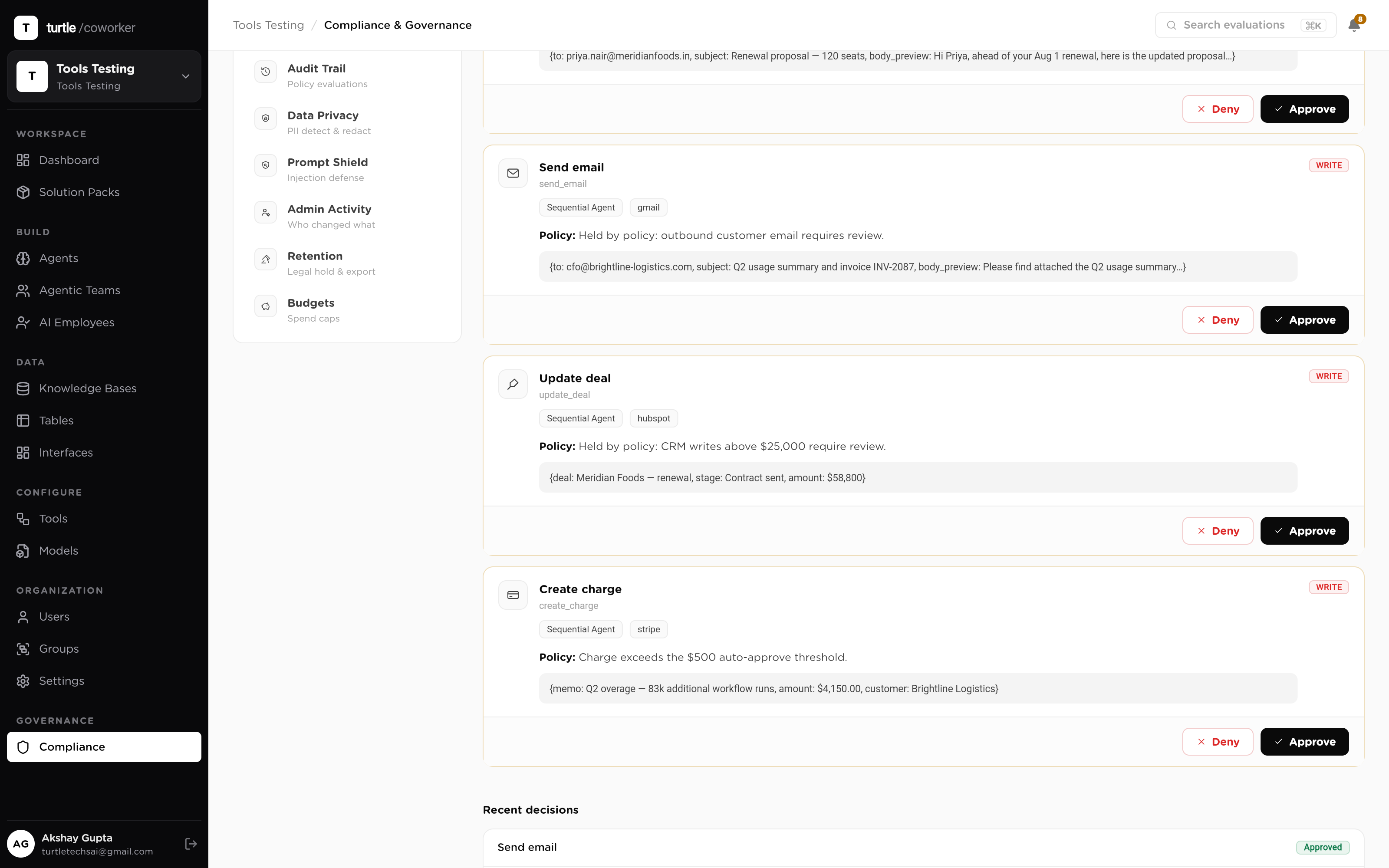
The approvals queue listing held actions, each row showing the action that was stopped and the rule that held it, with review controls
Every outbound release waits here until counsel signs it
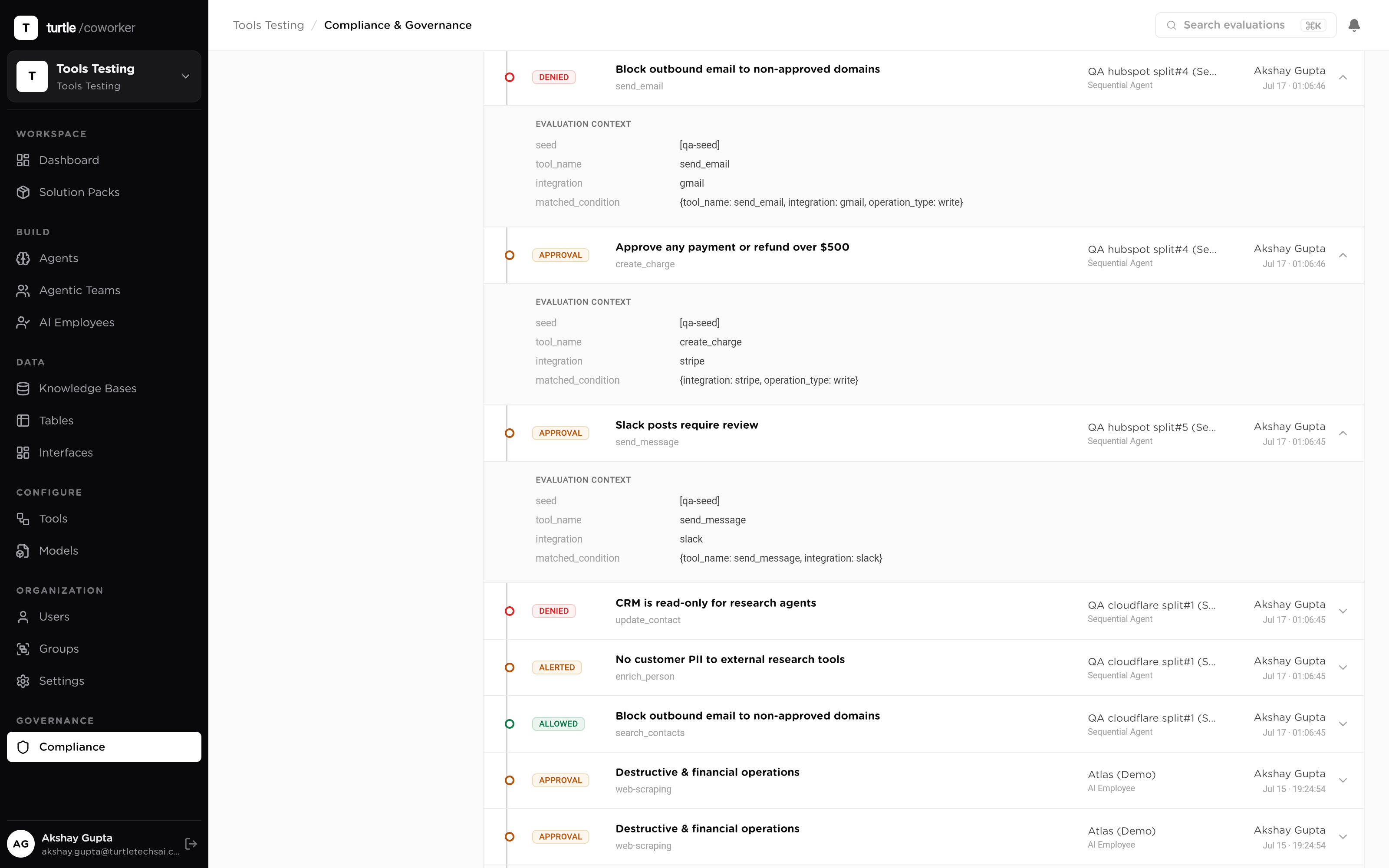
A single run's audit detail: per-tool-call rows listing each call's inputs, results and status, in the order they executed
The matter's full trail, call by call, a record you can produce, not reconstruct
Governed by default

The gates ship with the system.

01 · PLAYBOOK-GROUNDED

Cited deviations, no invented positions

Every flag cites the playbook rule it deviates from; document answers come from your knowledge bases with citations, and gaps escalate to counsel instead of being guessed. Inbound contract text is untrusted input, so a prompt-injection shield screens it before it reaches a model. The control plane →

02 · RELEASES HOLD

Nothing external without counsel

Redlines, signature requests, filings: every external release holds at the approval gate, enforced at the tool call, at runtime, so an unapproved send is a no-op. Each approval is single-use: one grant, one release, 24-hour expiry, and counsel can delegate approvals when out of office. How approvals work →

03 · A DEFENSIBLE RECORD

Every access on the record

A PII policy with redaction governs what agents store; every document access and tool call lands in the audit trail, pinned to the config version that ran; and every run's spend rolls up against budgets with hard caps. When someone asks how a matter was handled, you show the record.

Get the whole motion, pre-wired
Legal Intake and Paralegal Ops Official
Everything on this page (the matter table, the workers, Lex, the gates) installs as one system in about 20 min, verified with a smoke test. The full blueprint is readable before you sign up.
Start smaller

Legal templates, ready to clone.

All templates
Questions

Before you install.

Is this one AI, or a lot of them?
One workforce, several kinds of worker. The repeatable jobs (intake an agreement, run the first pass against your playbook) go start to finish on their own as unattended plays; a complex agreement where liability, term and IP have to be weighed together is assembled by a room of specialists; and you talk to one coworker that runs the intake desk. You never wire this together or choose an architecture. You delegate the outcome, and the workforce brings the right shape of worker to each part of the motion. Every one of them reads and writes the same record and obeys the same gates.
Is this giving legal advice?
No, and it's built so it can't drift into it. The review checks inbound terms against your playbook: your standard positions, your fallback clauses, your walk-away terms. Every flag cites the specific rule it deviates from, and anything the playbook doesn't cover escalates to counsel instead of being answered. It produces a first-pass markup for a lawyer to judge, never a legal opinion of its own.
Can it send a redline or sign anything on its own?
No. Every external release (a redline, a signature request, a filing) stops at an approval gate, enforced at the tool call, at runtime. Counsel reviews the flagged clauses with their playbook citations and approves, and each approval is a single-use grant: it releases exactly that one action and expires within 24 hours. The next release asks again.
What about privileged and confidential material?
Data handling is policy, not promise. A PII policy with redaction applies to what agents store and pass along, access is scoped by org roles, and every access to a document (who, when, through which tool) lands in the audit trail, pinned to the exact configuration that ran. When someone asks how a matter was handled, the answer is a record you can produce, not a reconstruction.
What happens when a contract raises something the playbook doesn't cover?
It escalates. An unrecognized clause, a term with no standard position, a question your knowledge bases don't answer: these route to counsel as a first-class outcome, with the contract, the matter row and everything found so far attached. The failure mode is a handoff to a lawyer, never an invented position in a counterparty's inbox.
How long until it's running?
About 20 min. You answer a few setup questions (which agreement types, which playbook rules, which approval gates), point it at your playbook and precedent documents, and the installer wires the matter table, the workers and Lex together, verified with a smoke test and ready for a first run.
Solutions · Legal

The first pass is done by morning. The final say never left counsel.

Book a demo Install Legal Intake and Paralegal Ops