Solutions · E-Commerce

Your whole store back office,
run by one AI-native workforce.

A store is a handful of judgment calls wrapped in a mountain of repeatable work: order questions, returns, refunds, catalog upkeep. An AI-native store functionputs the whole back office on a workforce that runs it around the clock, while every refund over your threshold and every storefront change still waits for you.

Installed in about 20 min. Governed and audited from the first run.

OVERNIGHTThis morning's desk
42 order questions answered from policy
11 returns processed in policy
1 refund over threshold holding
2 price changes holding for approval
one workforce · governed · audited · cfg v3
The whole function, on one workforce

Not a chat widget bolted onto the store.
The back office, end to end.

Every stage of the store's back office is worked by the right kind of worker (an unattended play, a team that faces your customers, a room of specialists), all reading and writing one shared record, with you at the gates that matter.

You delegate to one coworker. It runs the back office and brings you the calls that touch margin.
faces your market
Answer the order
  • Look up the order
  • Pull the shipping status
  • Reply from your policy
runs on its own
Process returns
  • Apply the returns policy
  • Issue within threshold
  • Escalate the exceptions
runs on its own
Hold the refunds
  • Refunds above threshold hold
  • Show the order and the rule
  • Release only on approval
holds for a person
a room of specialists
Keep the catalog
  • Draft descriptions
  • Price changes hold for approval
  • Never push live unsigned
holds for a person
runs on its own
Watch & report
  • Budgets with hard caps
  • Compile the briefing
  • Price per resolved issue
One shared record underneath. Every stage reads and writes the same orders, returns and catalog, under one rulebook of gates, budgets and audit.
Every step lands in the audit trail, pinned to the config that ran, so the whole night is provable afterwards.
One workforce, several kinds of worker

One team. The right shape of worker for each job.

You don't wire this together or choose an architecture. You describe the outcome; the workforce brings the right kind of worker to each part of the store, and they all work from one shared record, under one set of rules.

Workers that run a play to the end

The repeatable plays (process an in-policy return, draft a product description) run start to finish on their own, unattended, overnight.

A team that faces your customers

Order questions are met in the moment by a team that answers from your live order data and your published policies, cited, and escalates the second it isn't sure.

A room of specialists

When a catalog change needs the copy, the pricing and the stock reconciled at once, a room of specialists assembles it together, each owning its part.

A coworker you delegate the back office to

You don't operate a dashboard. You talk to one coworker that runs the back office, remembers your standing instructions, and brings you only the calls that touch margin.

One shared record, one rulebook

Every worker reads and writes the same orders, returns and catalog, and every one obeys the same gates, budgets and audit. No worker is ever off the leash.

What you never build

There's no integration project and no architecture to pick. You delegate the outcome, the workforce assembles the right workers, and every one of them lands under the same gates and audit.

What this makes possible

The ops team you'd hire for Q4, without hiring for Q4.

Run the math: a queue that never sleeps and a returns policy nobody has time to apply consistently is where margin quietly leaks. The workforce owns the repeatable order work continuously and hands you the calls that are genuinely yours. The week shifts like this (a worked scenario, not a benchmark):

01
Order questions answered on arrival, from real order data

“Where is my order?” at 1 AM gets an answer at 1 AM: the actual order looked up, the carrier status pulled, the reply grounded in your published shipping policy and cited. Never improvised, because an invented policy in a customer inbox is a real cost.

02
Returns processed inside policy, automatically

Returns that sit inside your published rules are checked and processed without waking anyone. The eligible ones move; the exceptions escalate. Volume stops being a headcount problem.

03
Refunds above threshold held, margin protected

Any refund over your threshold always stops at the gate, margin protected structurally, not by whoever is tired at midnight. One approval releases exactly one refund.

04
Peak volume absorbed without seasonal hiring

Volume scales; headcount doesn't have to. Budgets with hard caps keep run spend bounded, and cost per resolved order-issue is a number in the morning briefing, priced from real run spend.

The store todayWith the workforce
1 AM order-status askwaits for the morninganswered from order data on arrival
In-policy returnshand-worked, one by onechecked and processed automatically
Refunds over thresholdleak under volumehold at the gate, rule shown
Catalog updatesa permanent backlogdrafted, queued for approval
Peak seasonseasonal hires and burnoutabsorbed by the same team
What running it feels like

You run the store from one conversation.

Coral isn't a dashboard you operate, it's the coworker you delegate the back office to. The night's order questions, the returns processed, the one refund that needs you: it arrives summarized, the pieces that touch margin are already queued with their evidence, and each approval releases exactly one thing.

Every message, tool call and approval in this exchange lands in the audit trail. How the gates work →

LIVEMorning check-in with Corale-commerce workspace
Coral, how did the store do overnight?
CO
Coral · Store operations42 order questions since close, answered from order data and the shipping policy. 11 returns processed inside policy. One refund needs you: $310 on a worn item, above your threshold.42 answered11 auto-returns1 held
lookup_order(#8213) → delivered Jul 14 · return window open to Jul 28
issue_refund · $310 · order #8213, over the $150 auto-approve threshold
Item's worn, partial per policy. Approve $155.
CO
Coral · Store operationsDone. $155 refunded under the used-condition rule in your returns policy, customer notified with the policy cited. That grant covered exactly this refund, so the next one asks again.cited: returns-policy §4single-use grant
refund executed · customer notified · logged to audit trail, cfg v3
Proof, not promises

One overnight, across the whole back office.

A scenario: a DTC brand with a $150 refund auto-approve threshold and a published returns policy. These are real screens, not mockups.
LIVEOne night at the store, end to endrun #5177 · e-commerce workspace
1:23 AM
arrived“Where is my order, and I want a refund”A customer email lands hours after the last person logged off. The text is screened by the injection shield before it can steer anything.
1:23 AM
workforceOrder looked up, shipping pulled, reply sentOrder #8213 looked up, carrier shows delivered Jul 14. The reply is drafted from the shipping and returns policy, citations attached. This org earned the gate down for cited, low-risk replies.
1:24 AM
workforce$96 refund inside policy, processedUnopened item, inside the return window, under the threshold. The refund and return label go out under standing policy; no one is woken up.
3:05 AM
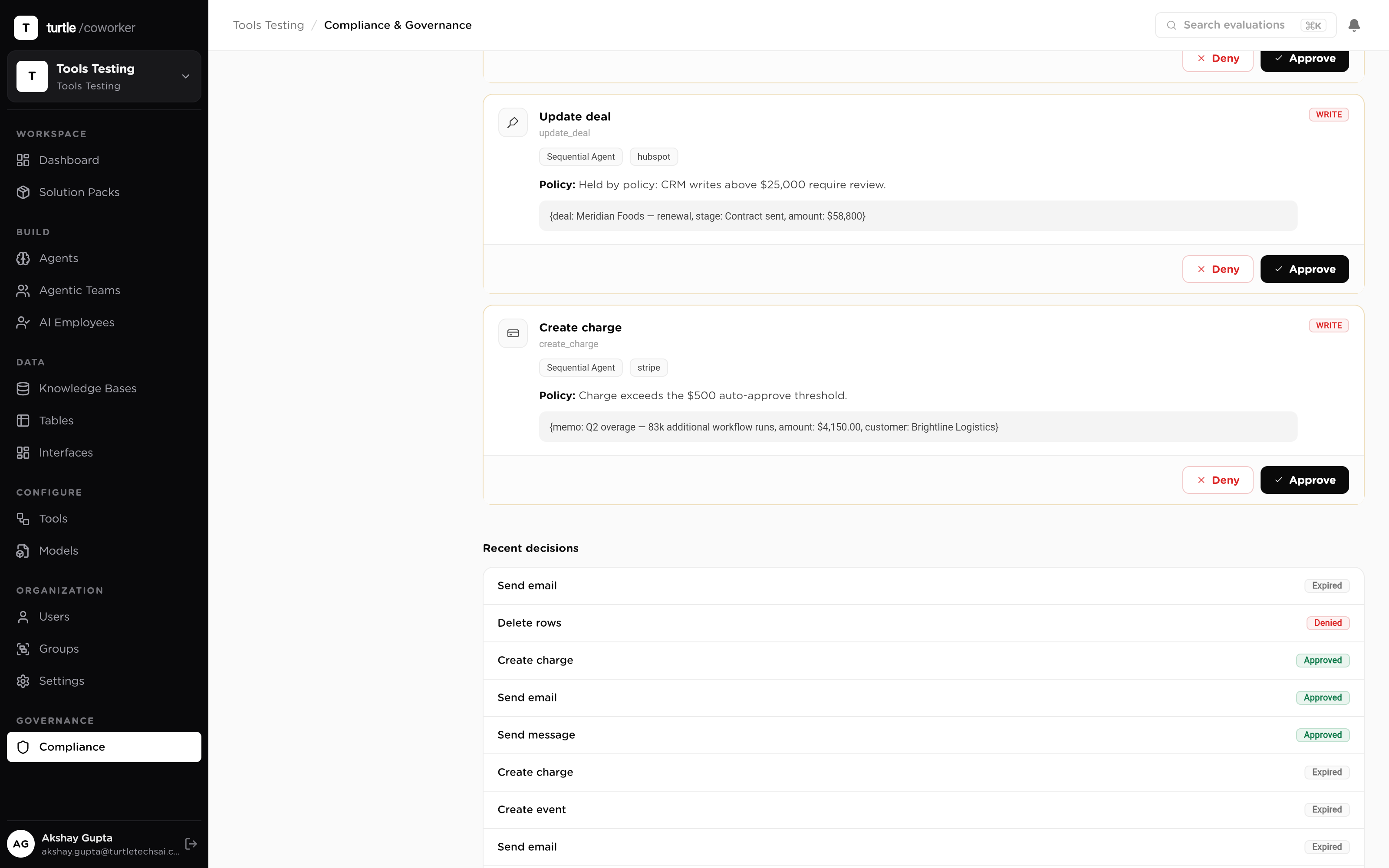
heldA $310 refund holdsA second request, a worn item, $310, above the $150 threshold. It waits in the approval queue with the order history and the policy rule as evidence. Customer answered; money unmoved.
9:02 AM
humanPartial approved, per policyThe ops lead reviews the order history against the used-condition rule and approves $155 partial. Single-use grant: it releases this refund and nothing else.
9:02 AM
doneExecuted, night pricedCustomer notified with the policy cited. 42 questions handled, two refunds settled, one human decision, all of it in the audit trail, pinned to cfg v3.
A payment held at the approval gate: the refund amount stopped above threshold, the policy rule that held it, and the supporting evidence shown beside the approve and deny controls
The $310 refund waits for a person, with the rule that held it shown
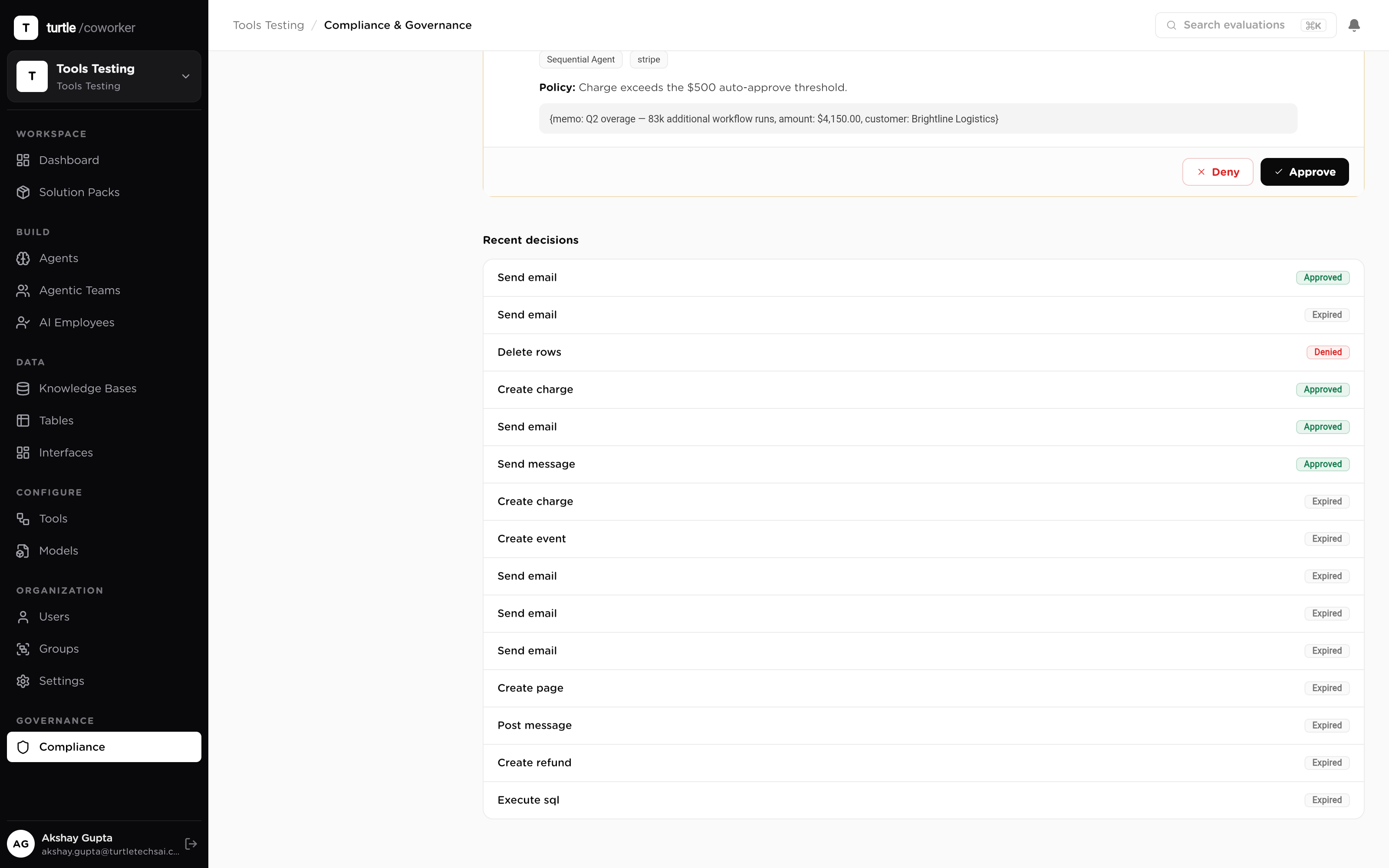
A single-use approval grant in the product: one grant tied to one specific action, shown consumed after that action executed
One approval, one refund, the grant is spent the moment it's used
Governed by default

The gates ship with the system.

01 · GROUNDED, NOT GUESSED

Replies cite your policies

Customer answers are drafted from your shipping and returns policies, retrieved and cited; what the docs can't ground escalates to a human. Inbound customer text is untrusted input, so a prompt-injection shield screens it before it reaches a model. The control plane →

02 · MONEY & STOREFRONT HOLD

Refunds and price changes wait

Refunds above your threshold and every catalog change hold at the approval gate, enforced at the tool call, at runtime. Each approval is single-use: one grant, one refund, 24-hour expiry, then the next one asks again. How approvals work →

03 · AUDITED, AND PRICED

Every touch traced, every run costed

Every lookup, reply, refund and catalog draft lands in the audit trail, pinned to the config version that ran, and every run's spend rolls up under budgets with hard caps, so cost per resolved order-issue is a number you read, not estimate.

Get the whole back office, pre-wired
E-commerce CX and Returns Official
Everything on this page (the shared record, the workers, Coral, the gates) installs as one system in about 20 min, verified with a smoke test. The full blueprint is readable before you sign up.
Questions

Before you install.

Is this one AI, or a lot of them?
One workforce, several kinds of worker. Some jobs run as unattended plays that go start to finish on their own; order questions are met by a team that faces your customers; a catalog change is assembled by a room of specialists; and you talk to one coworker that runs the back office. You never wire this together or choose an architecture. You delegate the outcome, and the workforce brings the right shape of worker to each part of the store. Every one of them reads and writes the same record and obeys the same gates.
What stops it inventing a shipping or returns policy?
Replies are drafted from your own published policies and docs, retrieved and cited, so you can see exactly which passage backed the answer. When the docs don't answer, the question escalates to a human instead of being guessed at. And inbound customer text is treated as untrusted input: a prompt-injection shield screens it before it reaches a model, so a crafted email can't talk its way into a refund.
How do refunds actually stay controlled?
Structurally, not by convention. Your refund threshold is enforced at the tool call, at runtime, so a refund above it cannot execute without an approval, no matter what the conversation looked like. Each approval is a single-use grant: it releases exactly one refund and expires in 24 hours, so a Tuesday yes can't quietly cover Thursday's request. In-policy refunds below the line process automatically, which is the point: discipline where it matters, speed where it doesn't.
Can it change prices or product pages on its own?
No. Catalog work (descriptions, pricing, stock states) is drafted and held at the gate. You review the change next to the current live version and approve or reject it; nothing reaches the storefront without that decision. What you get is the backlog cleared as drafts, not surprises on your product pages.
What does peak season cost?
A bounded number, not an open tab. Every run's spend rolls up, so cost per resolved order-issue is a figure you read in the morning briefing, and budgets with hard caps stop spend at the line you set, with circuit breakers to halt a misbehaving run outright. As a worked scenario, not a benchmark: if overnight volume triples in December, the queue triples and the budget cap doesn't move unless you move it.
How long until it's running?
About 20 min. You answer a few setup questions (your refund threshold, which replies auto-send, which always hold), connect the store and inbox tools you already run, and the installer wires the shared record, the workers and Coral together, verified with a smoke test and ready for a first run.
Solutions · E-Commerce

The orders get answered at 1 AM. The refunds wait for you.

Book a demo Install E-commerce CX and Returns