
Insurance renewal automation means an AI assistant runs the 90/60/30-day renewal sequence off your policy book — drafting each touch, prepping review summaries, and flagging lapsed clients for win-back — while a licensed human reviews and sends every message. Nothing quotes a premium or binds coverage; the AI handles the calendar, the human handles the client.
A renewal dies quietly on a Tuesday
Here’s how a good agency loses a policy it should have kept. Nobody is lazy and nobody makes a mistake you could point to.
A commercial package renews in 92 days. The producer knows — it’s in the management system, along with four hundred other expiry dates. The plan is the same as always: reach out around 90 days, do a coverage review around 60, confirm at 30, renew. But this particular Tuesday there’s a claim blowing up, two new-business quotes due, and a carrier portal that logged everyone out. The 90-day touch slips to “next week.”
Next week it’s 83 days, which still feels fine. Then a vacation, a marketing push, a staff change. At 40 days someone notices the file has no activity, sends a rushed “your policy is coming up” email, and hopes. There was no review, so nobody caught that the client added a second location. The client, meanwhile, got a call from another agent who did reach out on time. The policy doesn’t renew. Nobody decided to lose it; it just wasn’t touched at 90, 60, and 30.
Ask any agency principal about their renewal process and you’ll hear the same quiet confession: the sequence exists on paper, and it runs on whoever has a free hour. The book — your book of business, the recurring revenue you already earned — leaks through the gaps in that hour.
What does a leaky book actually cost?
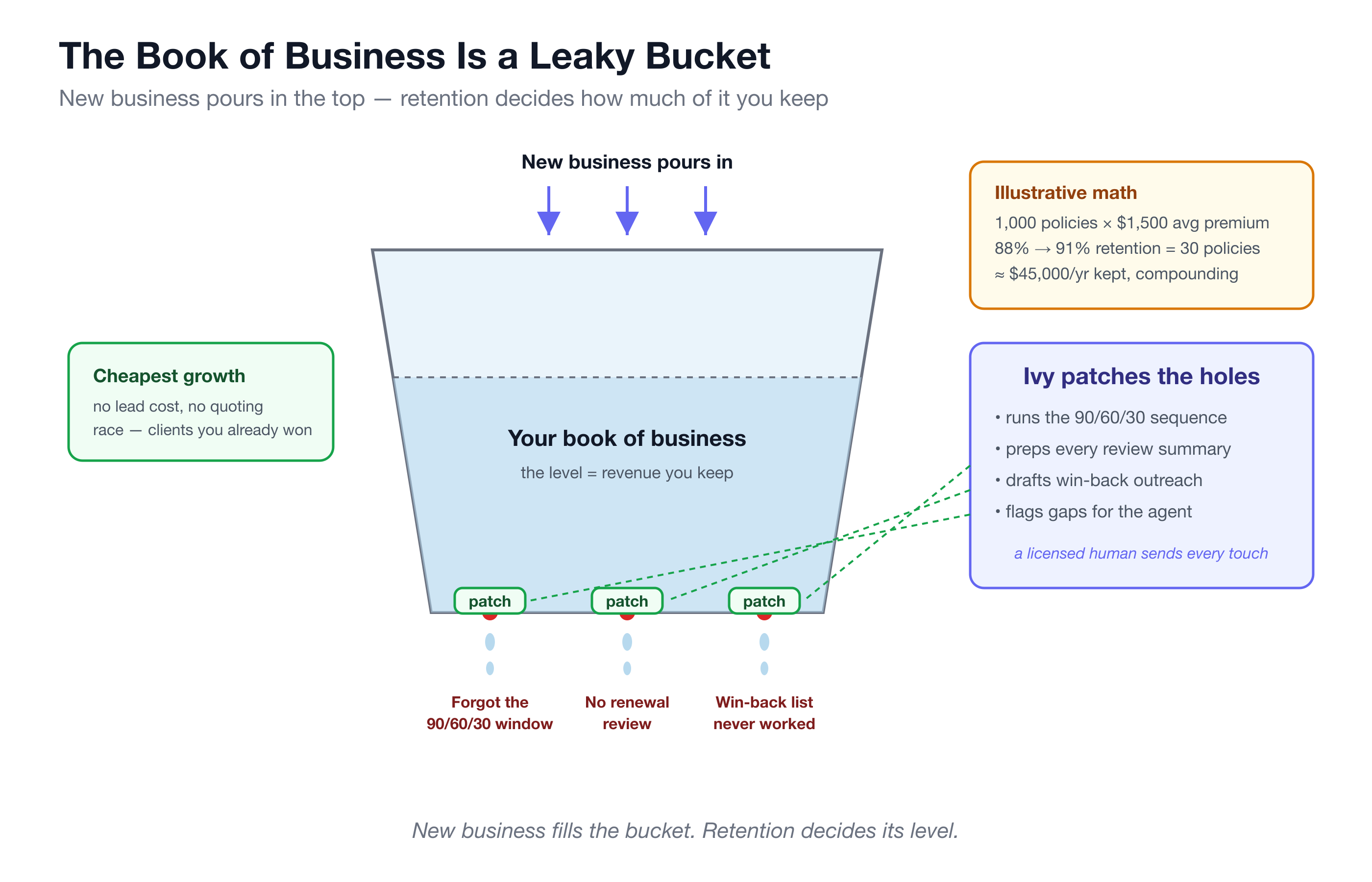
The math is unglamorous, which is exactly why it gets ignored. Take an illustrative book of 1,000 policies at an average $1,500 in annual premium — a $1.5M book. Suppose retention sits at 88%.
Every year, 120 policies walk. Some of that is unavoidable — businesses close, people move, carriers non-renew. But industry-standard breakdowns of preventable loss point at the same three holes: the renewal window nobody worked, the review that never happened (so the client never heard why their price changed), and the lapsed client nobody ever called back.
Now suppose disciplined 90/60/30 contact lifts retention by just three points, from 88% to 91%. That’s 30 policies a year that stay — $45,000 in premium retained on this example book, every year, compounding, before you count the cross-sell conversations a proper review surfaces. Retention is the cheapest growth there is: no lead cost, no quoting race, no new-business commission split. You already won these clients once. Every retention point is real revenue you don’t have to go win again — the arithmetic works the same way as the ROI math for any AI employee: recovered hours and recovered revenue, counted honestly.
And here’s the structural point that makes this different from new business: renewals are dates-and-sequences work — there is no phone race to lose. You know the expiry date months out. The work is showing up on schedule, every time, for every policy. That’s not a sales talent problem. It’s an operations problem, and operations problems are what software is for.
What does policy retention AI look like in practice?
The Insurance Renewal and Retention Solution Pack on Turtle AI Coworker installs Ivy, an AI retention assistant whose entire job is making sure the sequence runs. Concretely:
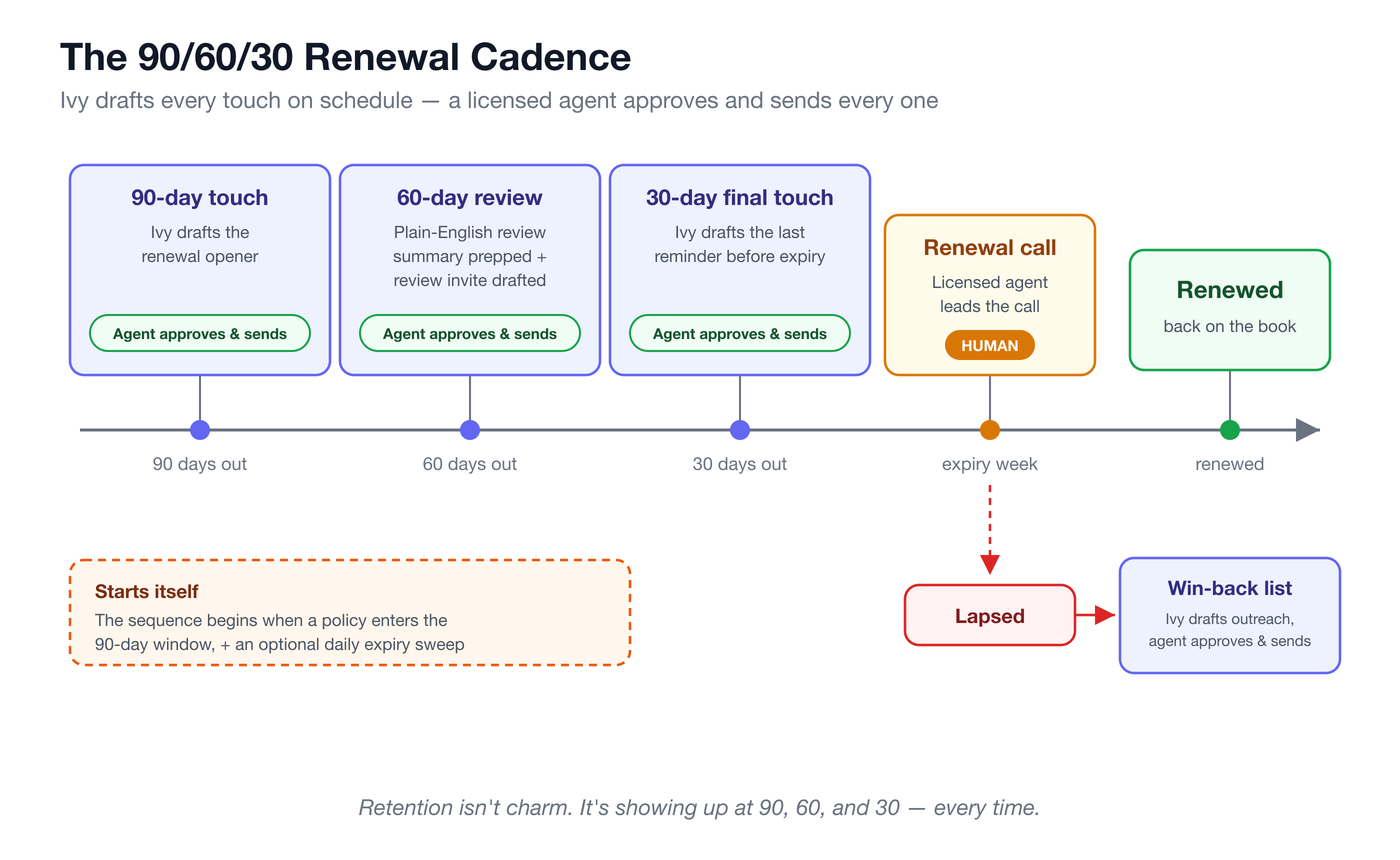
- Ivy drives the 90/60/30-day renewal sequence off your policy table. When a policy enters the 90-day window, the sequence starts automatically — no one has to remember to kick it off. An optional daily sweep catches upcoming expiries so nothing enters the window unnoticed.
- She drafts the right touch for each stage. The 90-day opener, the 60-day review invitation, the 30-day final touch — each drafted in your voice, following the renewal playbook and retention scripts in the pack’s knowledge base.
- She prepares plain-English review summaries for client calls. Before the 60-day review, the agent walks in with a summary a client can actually follow — what’s covered, what changed — instead of skimming the file in the parking lot.
- She spots coverage gaps worth an agent’s attention. New exposure, thin limits, a policy type the client doesn’t have — logged to a cross-sell opportunities table as internal suggestions for the agent. These notes are never sent to a client; they’re prep for a licensed professional’s conversation.
- She drafts win-back outreach for lapsed clients. More on that below, because this is the list almost nobody works.
Four tables hold the operation — your policy book, the renewal pipeline, cross-sell opportunities, and the win-back list — so the whole book’s status is visible at a glance instead of living in one producer’s memory. A knowledge base holds your renewal playbook, coverage explainers, retention scripts, and compliance guardrails, and every touch Ivy drafts follows them.
Isn’t AI outreach an E&O nightmare?
Reasonable question — errors & omissions (E&O) liability, the professional-negligence exposure every agency carries, is exactly why most agencies haven’t automated client contact. So here’s the design, stated plainly:
Everything is draft-and-approve, and a licensed human sends every client touch. Ivy drafts; an agent reviews, edits if needed, and sends. Nothing goes to a client that a licensed professional didn’t release. (This is the same draft-and-approve pattern Turtle uses everywhere — in insurance it isn’t just a comfort feature, it’s the compliance posture.)
Nothing quotes or confirms a premium, and nothing binds coverage. Those are hard lines built into the pack, not settings you have to remember to configure. No autonomy dial unlocks them.
Gap and cross-sell notes are internal only. Ivy never sends coverage advice to a client. She flags what looks worth discussing; the licensed agent decides whether and how to raise it.
Compliance guardrails live in the knowledge base you control — your do-not-say rules, your state’s constraints — and every draft is checked against them before it ever reaches your approval queue.
The honest framing: the AI removes the part of retention that fails from forgetfulness, and leaves untouched the part that requires a license and judgment. The agent’s job gets better — more prepared conversations, fewer dropped windows — not thinner.
The list nobody works: win-backs
Every agency has one — the clients who lapsed two renewals ago, sitting in the management system under a status nobody filters for. Working that list is classic important-but-never-urgent: high-probability revenue (they already chose you once) that loses every priority contest to whatever is on fire today.
Ivy maintains the win-back list as a standing table and drafts the outreach — grounded in your retention scripts, honest about the gap (“it’s been a year — a lot may have changed on your end”), ready for an agent to approve and send. A list that got touched never becomes a list that gets touched weekly on its own; it becomes that because drafting the outreach stopped costing anyone an afternoon.
This isn’t only an insurance pattern
Generalize it for a moment: any business with a renewal or subscription book has this exact shape. SaaS renewals, maintenance contracts, memberships, retainers — a known expiry date, a sequence of touches that should happen before it, a review conversation that protects the relationship, and a lapsed list nobody works. If your revenue renews on dates you can see months ahead, retention is dates-and-sequences work for you too, and the same pattern — AI runs the calendar, human owns the conversation — applies. Insurance is simply the industry where the cost of a dropped sequence is most visible and the compliance stakes make draft-and-approve non-negotiable.
Frequently asked questions
Is this compliant with E&O requirements?
The pack is built to respect E&O: every client-facing message is a draft that a licensed human reviews and sends, and Ivy never quotes or confirms a premium and never binds coverage — those are hard limits, not configuration. Your own compliance rules go in the knowledge base and every draft follows them. As with any process change, confirm the setup against your E&O carrier’s guidance.
Does it give insurance advice to clients?
No. Coverage-gap and cross-sell observations are internal suggestions logged for an agent’s attention — they are never sent to a client. Advice remains a licensed agent’s conversation; Ivy’s job is making sure the agent walks into it prepared and on time.
What do we need to get started?
Import your policy book — that’s the one real requirement, since the whole sequence runs off the policy table. Connecting Google Sheets makes the import easy, Gmail lets approved touches send from the platform, and a calendar connection handles review bookings, but all three are optional. Setup takes about 20 minutes; the best first step is replacing the placeholder playbook and compliance rules with your own.
Will clients know they’re talking to an AI?
Clients receive messages your agent reviewed, edited if needed, and sent — in your agency’s voice, following your scripts. The AI’s role is preparation and timing; the relationship, the signature, and the send button stay with your team.
If your renewal process currently depends on whoever has a free hour, install the Insurance Renewal and Retention pack, import your book, and run it for one renewal cycle. Watch the 90/60/30 touches land on time for every policy, count the reviews that actually happened, and let the retention number tell you what showing up consistently is worth.